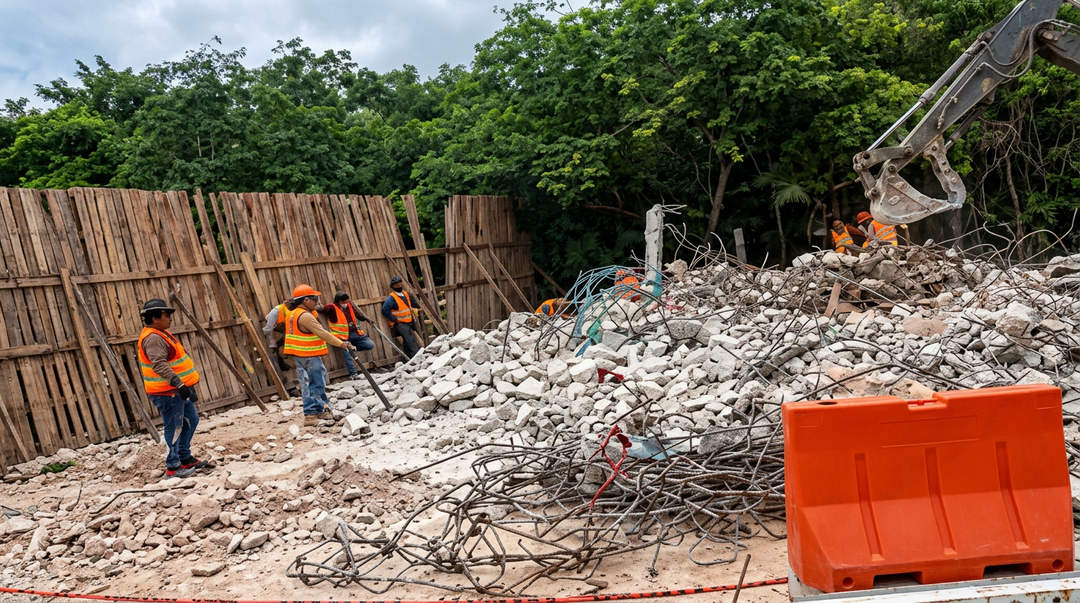

There is a particular silence in Tulum right now that anyone who loves this place will recognize. It is not the silence of the jungle at dawn, or the quiet of an early morning beach before the world wakes up. It is the silence of a restaurant that used to be full. Of a shop with a handwritten sign on the door. Of a hotel corridor where the footsteps stopped coming.
We are living through one of the hardest economic moments this destination has ever faced. And the most painful part is not the crisis itself. It is knowing that almost none of it was inevitable.
A Collapse Built Over Years, Not Months
The numbers are not subtle. Hotel occupancy in Tulum's coastal zone fell to around 30 percent during the summer of 2025, with rates in the town center dropping as low as 15 percent, according to Quintana Roo's tourism bureau. By October of that year, overall occupancy had settled at 49.2 percent, down from 66.7 percent just twelve months earlier. Airlines responded the only rational way they could: United and JetBlue suspended or cut routes, and Air Canada canceled its seasonal service entirely. Tulum's new international airport, which opened in late 2024 with enormous fanfare, handled 3,514 international operations in the first seven months of 2025, compared to 5,026 for all of 2024.
Over the past 18 months, the Quintana Roo Commerce Council recorded a 15 percent reduction in long-standing local businesses. Nearly half the shops along Tulum's streets are now closed. Hundreds of families who built their livelihoods around tourism are left with nothing. These are not abstractions. They are neighbors, vendors, cooks, and guides who watched a model collapse around them while the warnings they had been sending for years went unanswered.

When the Price Stopped Making Sense
Tulum spent years selling a myth at a cost that eventually stopped adding up. Average room rates reached $450 per night in 2025, a 25 percent jump from 2023. Beach clubs required minimum consumption of $80 to $200 per person just to sit near the water. A short taxi ride from the hotel zone to town could cost more than a full meal in most Caribbean destinations. And in exchange for all of that, visitors found potholed roads, inconsistent electricity, water rationing in multiple neighborhoods, and an atmosphere that felt less like the bohemian paradise it had once been and more like an expensive stage set with missing infrastructure behind it.
One tourism industry executive described it with uncomfortable precision: Tulum was charging New York prices while delivering something considerably less. The destination had overestimated the loyalty of a traveler who now had better options, better information, and no patience for being treated as a revenue extraction target.
What the Rest of the World Was Offering Instead
The traveler who left Tulum did not disappear. They landed somewhere else. And that somewhere else, in almost every measurable category, offered more for less.
The Caribbean Neighborhood: Punta Cana
A four-star all-inclusive resort in Punta Cana averaged $239 per night in 2025. A five-star property averaged $422. Both figures sit well below what a comparable experience cost in Tulum, and both came with something Tulum could not reliably offer: predictability. Punta Cana operates with a dedicated tourist police force of more than 200 CESTUR officers patrolling resort areas around the clock. Beaches are open, public, and free. Ride-sharing and regulated airport transfers eliminated the negotiation anxiety that defined every Tulum arrival. The Dominican Republic carries the same U.S. State Department Level 2 advisory as Quintana Roo, but in Punta Cana that advisory applies to a country where 4.5 million tourists visited in 2025, the single most visited destination in the Caribbean, and the vast majority of reported incidents amounted to nothing more serious than a sunburn.

Punta Cana did not invent anything extraordinary. It simply built a system that worked, kept it working, and priced it honestly.
Europe on a Caribbean Budget: Portugal's Algarve
For travelers willing to cross the Atlantic, Portugal offered something that would have seemed impossible a decade ago: Western European infrastructure, safety standards that place the country among the top ten most peaceful nations on earth according to the Global Peace Index, Level 1 status from the U.S. State Department, and an average hotel room cost of around $144 per night across the country. In the Algarve, the premium coastal region with cliffs, turquoise water, and world-class golf, rates rose to an average of 206 euros per night in peak 2025, still below what Tulum's hotel zone was charging for properties with broken roads outside the front door.
Portugal's public beaches are not only free but legally protected. Ride-sharing services operate without interference. A taxi across town costs a fraction of what the same distance costs in Tulum, with a meter running and a receipt waiting. The country ranked among the top ten safest in the world while Tulum's own security secretary was assassinated by organized crime in March 2025. These are not minor differences in experience. They are the difference between a destination that builds trust and one that erodes it.
The Other Side of the World, Half the Price: Bali and Thailand
For the traveler who calculated that a long-haul flight to Southeast Asia cost less than a week in Tulum after factoring in taxi fares, beach club minimums, and hotel rates, the math was not wrong. A mid-range hotel in Bali ran between $80 and $150 per night for a four-star property in 2025. A comfortable day in Thailand, including accommodation, food, local transport, and activities, could be managed for $80 to $150 total. Both destinations offered functioning app-based ride-sharing, Grab and Gojek in Bali, Grab throughout Thailand, with transparent fares, GPS tracking, and no negotiation required. The beach in Kuta, in Seminyak, in Phuket, in Krabi, was free. You walked to it. Nobody stopped you.
Bali welcomed millions of visitors in 2025 with an infrastructure built around the reality that tourists need to move, eat, and access the water without running a daily gauntlet of price manipulation. The comparison was not flattering to Tulum. It was not meant to be. It was the honest conclusion of a traveler doing what travelers now do before every trip: running a side-by-side comparison on a phone screen and asking where their money would go furthest.
The answer, for too many of them, was somewhere else.
Transportation and the Monopoly Nobody Stopped
Few things damaged Tulum's reputation as consistently, across as many years, as its transportation system. The local taxi union operated what functioned in practice as a price cartel without meaningful oversight. According to the State Mobility Secretariat, over 70 percent of complaints filed in 2024 were related to overcharging and fare inconsistencies. Tourists were charged amounts that bore no relationship to the distance traveled. Stories of drivers taking passengers to the wrong destination and then demanding additional payment circulated widely and without consequence.
The union's most lasting achievement was keeping ride-hailing services effectively out of Tulum. While legally permitted in theory, app-based transportation was almost never available in practice. The result was a destination where a visitor arriving with no local knowledge had one real option, and that option had no meter, no fixed price, and no accountability. A YouTuber with millions of followers documented being charged 2,000 pesos for an airport transfer. The story traveled further than any tourism campaign ever did.
The taxi union eventually came under formal investigation by state prosecutors. That investigation arrived years after the damage it might have prevented had already been done.
The Trust That Police Extortion Destroyed
In late September 2025, U.S. tourists were stopped at a checkpoint on Kukulkán Avenue and told their digital driver's license was not valid. Officers informed them the infraction warranted 36 hours of detention unless they paid immediately. They paid $1,100 USD, processed through a terminal registered under an official name, in two separate charges. Citizen organizations called for investigation, arguing that the use of official banking infrastructure pointed to something organized rather than opportunistic.
This was not an isolated case. Officers were filmed in Aldea Zama demanding 2,000 pesos from foreign tourists for a supposed traffic violation. A French visitor was escorted to an ATM and forced to withdraw cash before his documents were returned. Three officers were discharged in 2024, others suspended in 2025 for similar conduct. Each incident circulated internationally. Each became part of the story potential visitors read before deciding where to spend their money.
A destination cannot survive that story being told about it, year after year, without correction.
The Road Nobody Fixed and the Night Nobody Lit
The hotel zone road has been a documented complaint for as long as most businesses there can remember. Potholes, uneven pavement, no functional sidewalks, no adequate lighting after dark. The same corridor connecting tourists to Tulum's beaches and restaurants remained, for years, an obstacle that shaped first impressions and last memories in equal measure. One industry figure described the situation with painful clarity: four kilometers of beachfront, one road in and out, and a development model that kept adding luxury properties without addressing what was already broken underneath.
A rehabilitation project was eventually announced in 2025, covering 1.5 kilometers of resurfacing. Workers who use the route daily reported that earlier repaving had already deteriorated, with potholes reappearing in recently treated sections. The project arrived after the occupancy figures had collapsed, after the airlines had cut their routes, after the reviews had accumulated for years.
Walking Tulum's hotel zone after dark, in many stretches, still feels like moving through a place that has been left to itself. The darkness is not atmospheric. It is the absence of something that should have been there all along.
The Beaches That Stopped Belonging to Everyone
For a destination built entirely on the promise of its coastline, what happened to Tulum's beaches may be the loss that hurt most deeply. Hotels and beach clubs imposed cover charges, minimum consumption requirements, and in some cases outright exclusion of anyone not staying on the property. Mexican federal law has always guaranteed public beach access. What happened in Tulum was the gradual capture of that public space, year by year, until the beach that had drawn the world to this corner of Quintana Roo became something you had to pay to reach.
The situation reached its most visible breaking point when the Jaguar National Park imposed entrance fees for beaches that had always been free. Residents marched. The outrage was immediate and entirely legitimate. As one protester said during the demonstrations: "The beaches are life, they are history, they are the heritage of our grandparents and the future of our children."
By late 2025, 15 hotels and beach clubs had agreed to offer free access, and federal authorities had opened new public entry points. The concessions came only after occupancy had already reached historic lows. They came, as most corrections seem to come here, after the moment when they could have made the difference had already passed.
What It Would Have Actually Taken
None of the necessary changes were complicated. A taxi meter, enforced consistently. Competitive transportation alternatives permitted to operate without intimidation. Police accountability with real consequences for abuse. A coastal road maintained to the standard of the destination it served. Beaches left open, because they were always public and there was never a legitimate argument for restricting them.
These were not impossible demands. They were the basic conditions of a tourism economy that works. Punta Cana built them. Portugal maintained them for decades. Bali and Thailand made app-based transport available to every visitor who needed a ride. None of those destinations are perfect. All of them understood something Tulum did not: that a tourist who feels safe, moves freely, and reaches the water without paying a toll is a tourist who comes back.
The Paradise That Knew What It Needed
Tulum is not a place that ran out of beauty. The jungle is still there. The cenotes are still there. The color of the water on a clear morning has not changed. What changed was the relationship between this place and the people who came to experience it, and that relationship was damaged not by nature or by time but by a series of decisions, and a series of failures to decide, that accumulated over years into the crisis we are living now.
The tourists who stopped coming did not stop loving Tulum. Many of them loved it enough to warn, repeatedly and loudly, that something was going wrong. Those warnings filled review pages, social media threads, and travel forums for years before the occupancy figures confirmed what everyone paying attention already knew.
The answers were never hidden. They were visible in every complaint, every viral story, every family that packed up and chose somewhere else. A fair price for a taxi. An open beach. A safe street. A police force that protects rather than preys. A road you can walk at night without fear. That was all. And it was always enough.
The question that remains, now that the silence has settled over the empty restaurants and the shuttered shops, is whether it is still possible to rebuild the trust that was lost, one small correction at a time, before the window closes entirely. Tulum did not fall. But it was not pushed by any single hand. It was pushed by the accumulated weight of small decisions, missed opportunities, and the particular kind of blindness that comes from confusing what a place is charging with what it is actually worth.
Do you believe Tulum still has time to turn this around, or has the damage gone too deep? Join the conversation and share your perspective with us on Instagram and Facebook at @thetulumtimes.

The Tulum Times · Newsletter
The story continues in your inbox.
Essential Tulum news and local insight, a few times a week. Free.
No spam. Unsubscribe anytime.
Transportation in Tulum: Taxi, Bus, Transfers, and Mobility
Taxi fares, buses, transfers, road changes, mobility updates, and practical transport guidance for Tulum.

“The best journalists reporting from paradise, highlighting the heroes that keep Tulum the most beautiful place in the world! THANK YOU!”