The train horn blows "whooo-whooo" as the new Tren Maya is rolling. Notwithstanding controversy, 42 new trains now transit 1,500 kilometers of new track to 34 new stations encircling Mexico's verdant Yucatan Peninsula.
A first expedition aboard, from Tulum to Palenque's ruins and waterfalls by way of the enchanted lagoon of Bacalar, reveals world-class potential, room for growth, and tips for making your own first expedition.
On time from Bacalar
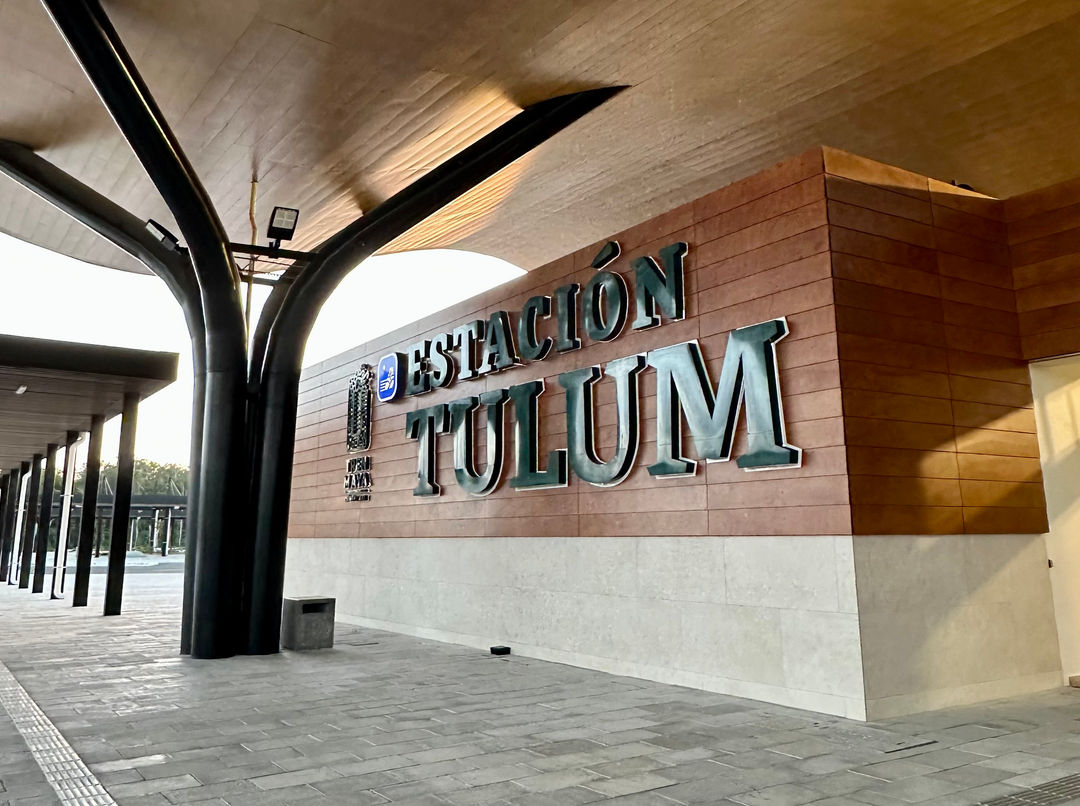
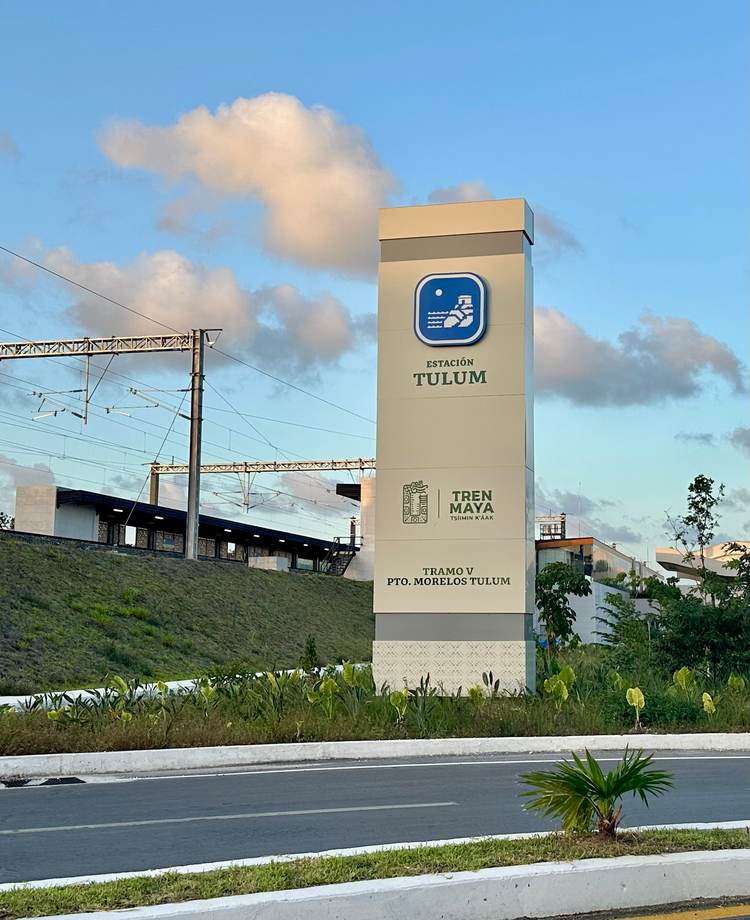
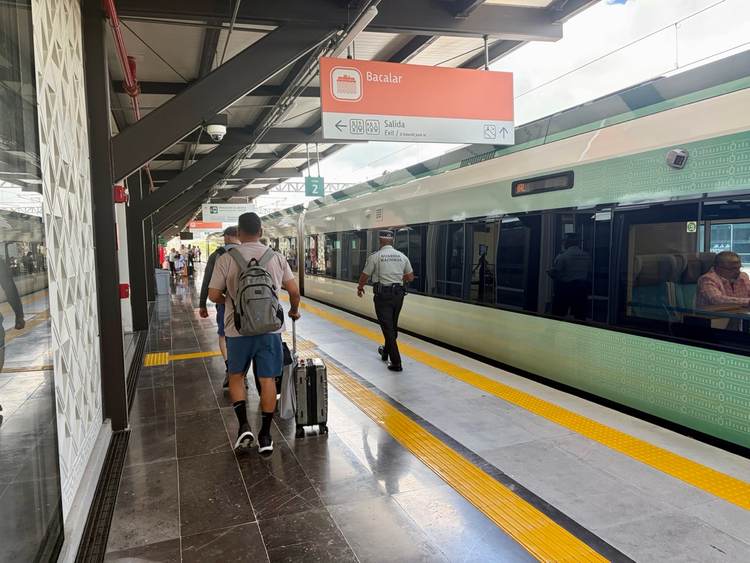
I shared a moment of wonder with my fellow passengers boarding at Tulum station as Tren Maya No. 601 smoothly approached us on the platform. The crisply uniformed train officers guided us aboard the sleek cars adorned with the Tren Maya green, teal, and cream motif to our reserved seats with matching decor. Wonder again as the train smoothly started forward, right on time, from the Tulum station, with its appealing wave-shaped architecture slowly, then quickly, falling away into the jungle now rushing by our panoramic windows.
It is this degree of completeness of the Tren Maya system that is such a pleasant surprise. We had seen the rail lines cleared and the stations rising from the jungle over the past few years, but perhaps with doubts about when a fully formed system would emerge, given the waylaid past public projects. But here we were, whisking along southward from an expansive, fully formed Tulum station on a modern electric train.

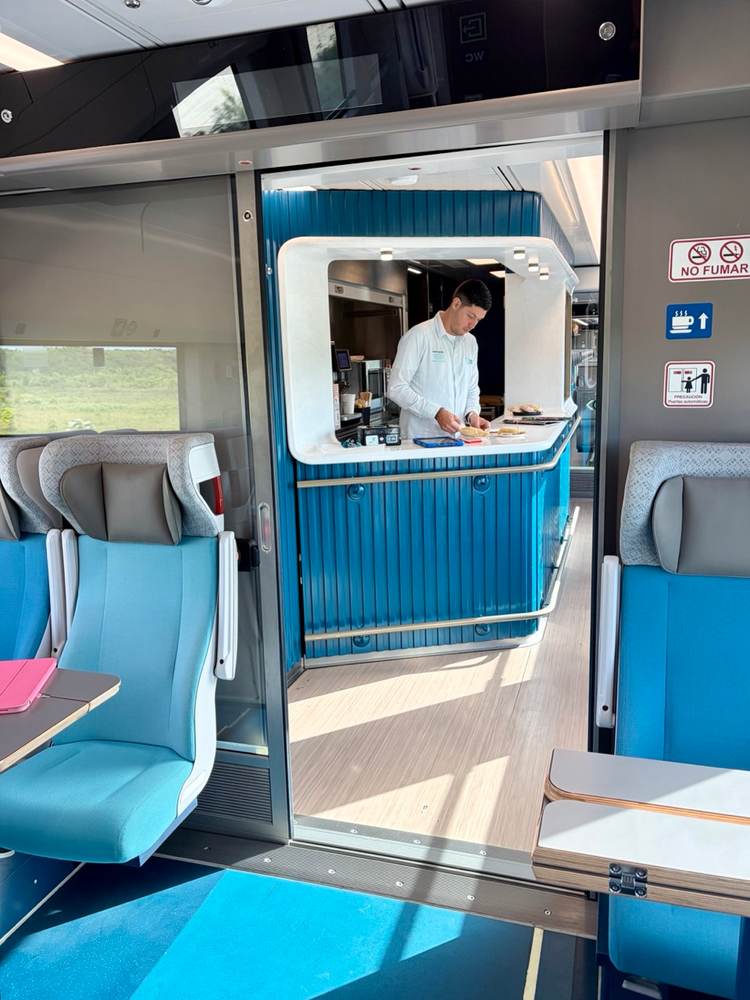
A proper dining car offers the typical snacks and drinks, plus regional items like pulled pork pibil sandwiches and corn husk-wrapped tamales, served up by friendly train staff proud of their striking new train. The seats are commodious, each with a pull-down desk and footrest, although Wi-Fi is not yet available, all the better to wonder out the window as you page through a good book. Cellular data comes back on as you pull into most stops.
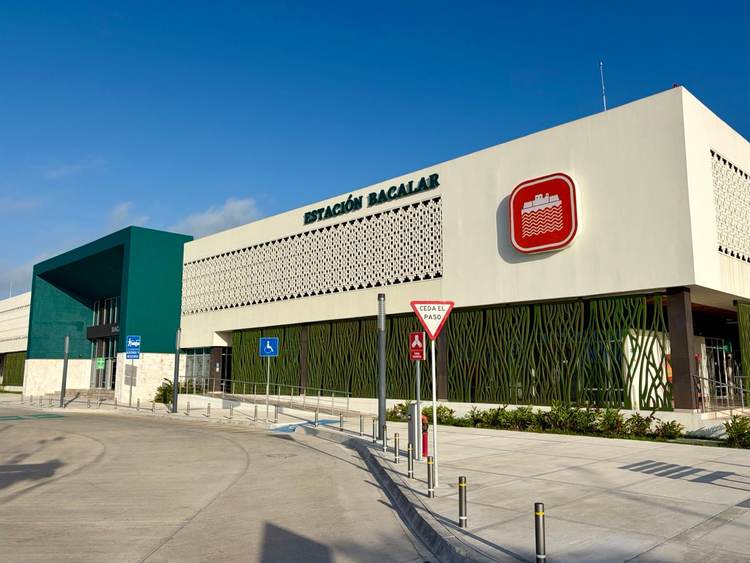
After just under three hours, our Tren Maya 601 pulls into Bacalar station. Unlike the wave-themed Tulum station, Bacalar's station reflects San Felipe Fort in Bacalar, which overlooks the town and the lagoon. Once again, the station's degree of completeness impressed, from secure bike racks outside to chilled water bottle fillers inside.
Like Tulum's station, Bacalar's station offers a plethora of retail spaces, most of which are not yet rented. Also like Tulum's station, Bacalar's is outside of town, one of the Tren Maya criticisms, although one can imagine land outside town was more readily available, and the stations themselves will hopefully spur growth around them. In Tulum, I had hailed a taxi to the station using the inDrive app on my smartphone, which is helpfully gaining popularity here. In Bacalar, I caught Tren Maya's 10-minute shuttle for 25 pesos from the palapa-covered front of the station to the town's plaza.
Bacalar rewarded my Tren Maya journey with two colorful days and nights. I sailed as the sun set over the lagoon with the well-run Adventure Labs from the dock of my fun lodgings at Yak Lake House, 1,050 pesos per night for my private water-view room. As the sun rose the next morning, I stand-up paddle-boarded through Bacalar's Rápidos at the end of the lagoon with Green Monkey SUP. Chef Carlo Meléndez delighted me with dinner at Costera 28 over the lagoon.

Ticketing tips, Tulum to Palenque
Travel from Tulum to Palenque currently requires two trains over two days, a first from Tulum to Bacalar or Chetumal, and a second onward to Palenque, because Tren Maya has not yet expanded to its anticipated night-time service. Alas, the Tren Maya website did not point that out, instead indicating "No Results Found" for a search of Tulum to Palenque, an improvement to be made.
Still, I found the 601 train departing Tulum at 10:45 a.m., arriving in Bacalar at 1:36 p.m. on the first day of my expedition. I planned two nights soaking up Bacalar, then found Train No. 701 departing Bacalar at 8:17 a.m., arriving in Palenque at 2:42 p.m., where I planned three nights. Because the return from Palenque to Tulum would currently also have required two trains over two days, I opted for the overnight ADO bus.
Tren Maya prices are dynamic, with the highest fares the day of travel, so it is cheapest to buy ahead of time once travel is certain. Tren Maya offers the choice of Premier Class, three seats across the car, two to the left and one to the right, or Tourist Class, four seats across, two on both sides. And Tren Maya prices vary across passenger categories, with the highest for international travelers and lower for Mexican nationals, who receive additional local, senior-citizen, and disabled discounts. Alas, my INM resident card did not qualify me for the lower national prices. Only a voter card from the INE qualifies.
As a first expedition, I bought tickets on my first day of travel at the Tulum station. Tulum to Bacalar cost 528 pesos, and Bacalar to Palenque cost 1,103 pesos, both in Premier Class. Tourist Class was almost the same, so I splurged. I had seen tickets online the week before priced at 411 pesos and 858 pesos respectively, about 30 percent less.
Onward to Palenque with Mennonites, Angelenos and World Cup fans
My next Tren Maya 701 from Bacalar to Palenque deepened my appreciation for the new system. My fellow passengers that morning included a cluster of Mennonite farmers boarding to Chetumal, overalls and broad-brimmed straw hats for the men, simple dresses and bonnets for the women. Jesus and Victor rode with me all the way to Palenque. Both Latinos, now married in Los Angeles, they were touring Quintana Roo for the first time, already planning a return trip around the new train. As we rolled westward through Campeche, a Mexican family boarded boisterously, all sporting the Mexican Tricolor as they headed to Palenque to join a World Cup viewing party for the June 18 game against Korea. As we crossed into Chiapas, the train's panoramic windows filled with views of the Sierra Madre mountains climbing up from the jungle.
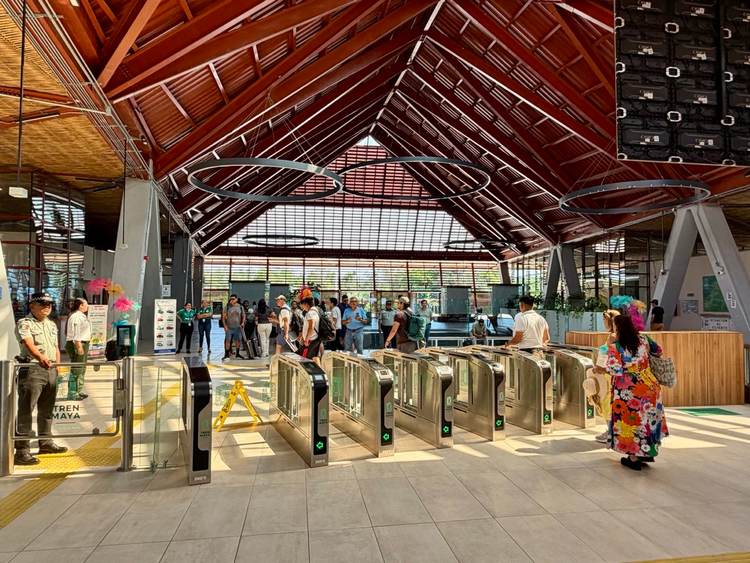
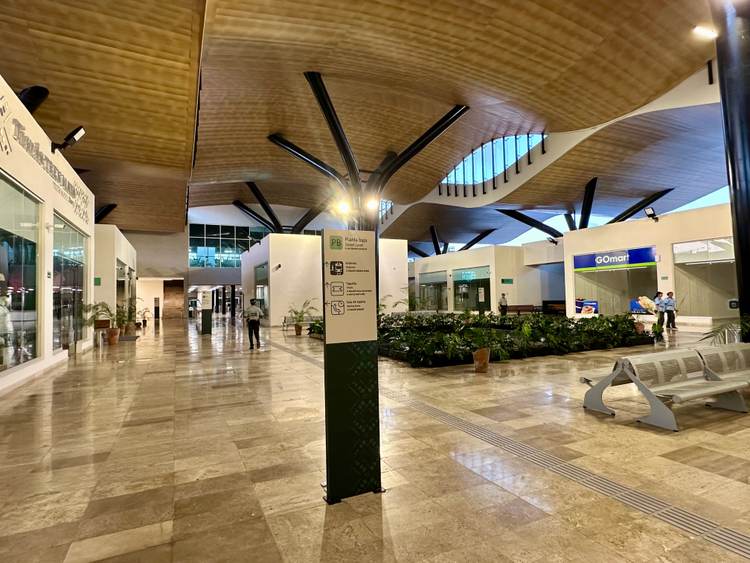
Our Tren Maya 701 glided into Palenque's majestic new station some seven and a half hours later, having fallen back by one hour while traveling westward. Whereas Tulum and Bacalar are way-stations along the Yucatan loop, Palenque is an end-of-spur, with the trains gliding in and back out of a grand train hall. Wooden rafters rose above in a triangle-and-circle formation as we stepped down from the train toward the spacious waiting area, sunlight streaming in from triangular skylights, then continued out to a circular park beyond, landscaped to extend the station's well-considered motif.
Down the escalator I went to the station's taxi stand. Palenque's station also offers a shuttle to the town center, but my Hotel Nututun nature resort, 1,000 pesos per night for my stay, is just beyond town, overlooking a clear blue bend in the Chacamax River. I had considered staying at Palenque's new Mundo Maya hotel, built by the military in conjunction with the Tren Maya here and by the Tulum, Chichen Itza, Uxmal and Calakmul stations, but online reviews of patchy service and patronage convinced me otherwise. Military precision behooves the Tren Maya, but perhaps not Mundo Maya hotels.
After cheering Mexico on to a win over Korea with the guests and waiters of Nututun's Don Manuel restaurant that first evening, I made my pilgrimage to Palenque the next morning. Goosebumps still rise as I recall emerging from the jungle to see the temples of King Pakal and his Red Queen rise up before me.
Nututun's tour service also brought me to swim the five cascades of Roberto Barrios and to hike beneath the plunge of Misol-Ha waterfall, further deepening that supreme sensation of wonder. And tasty were the grilled pollo asado and red peppers from Palenque's asaderos, particularly La Parrilla by the Barrios cascades.
Tren Maya in view of Roosevelt's parks and California's unbuilt train
Two parallels from the United States help put the Tren Maya in perspective. Just as President Andrés Manuel López Obrador ordered Mexico's military and the more than 600,000 workers counted by project chief Óscar Lozano to build the Tren Maya at the cost of 28 billion U.S. dollars, American President Franklin Delano Roosevelt ordered the Civilian Conservation Corps and 3 million workers to build up the roads and lodges of America's National Parks in the 1930s, at the cost of more than 3 billion dollars over nine years, worth over 61 billion in today's U.S. dollars. FDR's is now regarded as one of the most profitable public investments in American history. Whether AMLO's will be judged the same way is an open question, but that American parallel bodes well.
A second parallel, this one cautionary, is California's beleaguered effort to build a high-speed train from Los Angeles to San Francisco. Planning started 45 years ago, voters approved the project 18 years ago, yet service for even a meager initial section is not anticipated until 2030. In that light, Mexico's creation of a nearly 1,000-mile train system, three times the distance from L.A. to San Francisco, in just a handful of years is remarkable. Regulation can protect the environment and history, but it can also stifle progress. Whether the right balance was struck with the Tren Maya is still argued here, but California exemplifies a stalled balance Mexico avoided.
Ten years from now, it seems to this passenger, the Tren Maya will be thriving. Mexican and international tourists will embrace the ease, certainty, and safety of train travel around the Yucatan, as they have in Europe and other regions with world-class train systems. Indeed, Tren Maya international ridership in the first half of 2026 was up roughly 36 percent over 2025.
This first expedition to the Yucatan, with its rich history, epic nature, and authentic culture, showed that the Tren Maya may well prove a time-space leap, both literally, as the Yucatan is suddenly so connected, and figuratively, as the Yucatan springs ahead in global tourism.
The next piece to fall in place is the night train. Put it on the timetable, and this two-day expedition becomes a single overnight ride.
Would you ride the Tren Maya all the way from Tulum to Palenque, or is two days and a stop in Bacalar too much for one train trip? Join the conversation and share your perspective with us on Instagram and Facebook at @thetulumtimes.

The Tulum Times · Newsletter
The story continues in your inbox.
Essential Tulum news and local insight, a few times a week. Free.
No spam. Unsubscribe anytime.
Maya Train, Tulum Station, and Regional Connectivity
Coverage of the Maya Train, stations, routes, travel changes, and infrastructure decisions affecting Tulum.

“The best journalists reporting from paradise, highlighting the heroes that keep Tulum the most beautiful place in the world! THANK YOU!”