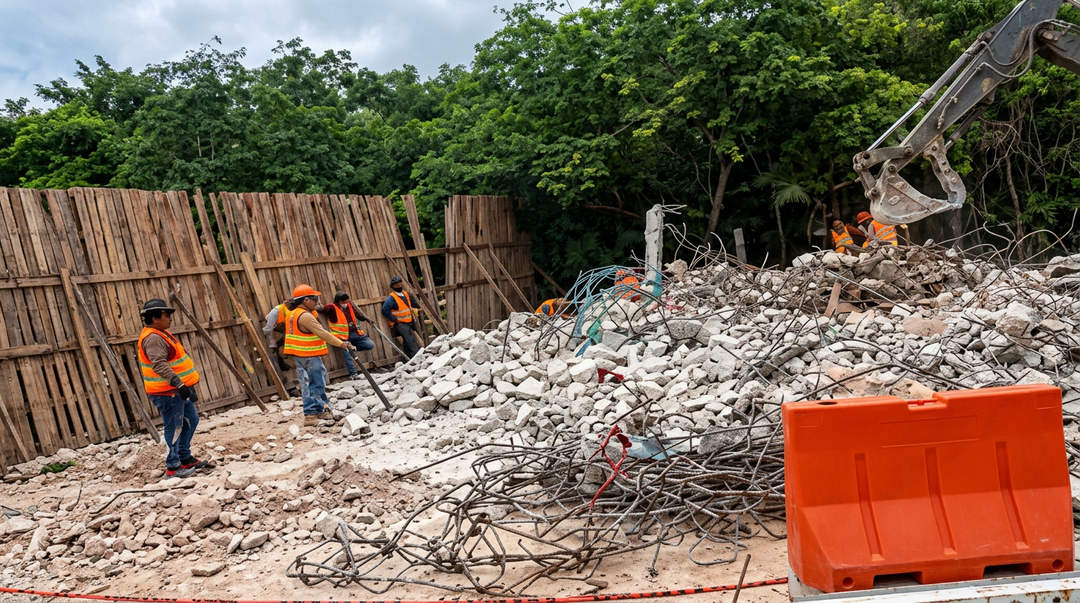
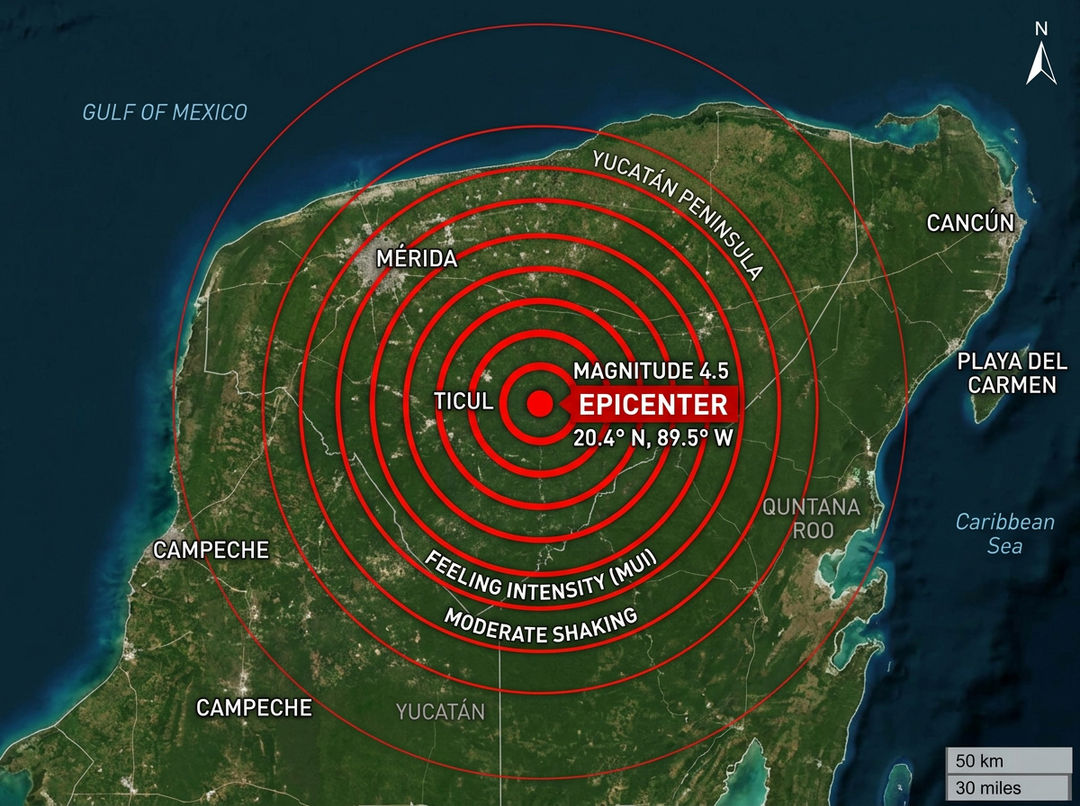
A magnitude 4.6 earthquake shook Quintana Roo before dawn on Sunday, June 21, with its epicenter 17 kilometers east of Felipe Carrillo Puerto and no damage reported by state authorities.
For the Riviera Maya, that made three perceptible earthquakes in June alone, and the latest entry in a run of activity that has stretched across more than half a year. The repetition has unsettled residents and tourists who assumed the local ground simply does not move.
A 4.6 quake before dawn near Felipe Carrillo Puerto
The Servicio Sismológico Nacional (SSN) placed the quake at 3:00 a.m. central time, 4:00 a.m. in Quintana Roo, at a depth of 16.5 kilometers. The Coordinación Estatal de Protección Civil de Quintana Roo confirmed that monitoring with municipal authorities and emergency crews found no structural damage and no injuries.
People near the epicenter reported feeling it. Farther north, in Tulum, Playa del Carmen, and Cancún, most residents slept through it. State officials called it the third felt earthquake in Quintana Roo this month and asked the public to rely on official channels rather than social media rumors.

A run that started in December
Sunday's tremor did not come out of nowhere. The unusual activity traces back to late 2025 and has continued in clusters ever since, which is what separates this period from the long stretches when years could pass without a felt quake.
The December 2025 swarm near Ticul and Muna
On December 5, 2025, Protección Civil Yucatán logged three quakes in a single night. The largest, magnitude 4.1, struck at 11:38 p.m. about 16 kilometers northeast of Ticul. Two smaller events of magnitude 3.5 and 3.7 followed near 3:45 a.m., with epicenters 17 kilometers south of Muna. All three were classified as minor.
March, May, and a single tense day in June
The peninsula recorded more movements through 2026, including events with magnitudes of 3.7 in March and 4.0 in May. By mid-June, Yucatán and Quintana Roo had accumulated at least seven felt earthquakes for the year, a figure well above the regional norm.
The most dramatic day was June 8. That morning at 10:05, the SSN registered a magnitude 4.2 quake near Chapab, about 14 kilometers northeast of Ticul, at a depth of five kilometers, tied to the Ticul fault zone. Around 1:00 p.m., a far stronger quake estimated at a magnitude of 6.1 struck off western Cuba, roughly 104 kilometers from the Quintana Roo coast, and its waves reached across the peninsula.

That afternoon, more than 2,500 people in Yucatán left public and private buildings. Offices, IMSS facilities, and corporate towers emptied, and in Cancún some restaurants moved diners outside. Municipal buildings in Benito Juárez, Playa del Carmen, and Othón P. Blanco were cleared as a precaution. Governor Mara Lezama confirmed no damage, normal operations, and no tsunami risk. A third movement closed the sequence at 4:19 a.m. on June 9, a magnitude 3.6 quake near Chapab, 11 kilometers north of Ticul, with no damage.
Why earthquakes in Quintana Roo happen at all
The Yucatán Peninsula sits in the interior of the North American plate, far from the boundary where the Cocos and North American plates grind against each other and produce dozens of daily tremors in Chiapas, Oaxaca, and Guerrero. That distance is the main reason quakes here are infrequent and usually weak.
The region also rests on a stable carbonate platform of limestone, the same rock that gives the peninsula its cenotes and underground rivers. That karst structure changes how seismic waves travel through the ground. The SSN has been explicit that the recent movements are not caused by collapsing caves or sinking terrain, but by natural geological processes linked to local faults.
The Ticul fault and its neighbors
The Ticul fault is the largest of those structures, a roughly 100 to 130 kilometer scarp running west-northwest from Maxcanú toward the south of Ticul. The peninsula also holds the Campeche–Hecelchakán and Holbox faults, which the SSN links to the handful of movements that are actually felt. Because the inland quakes are so shallow, often around five kilometers deep, they can feel sharp close to the epicenter even at low magnitude.
Juana Elia Escobar Sánchez, who heads the Geology Laboratory at the UNAM ENES campus in Mérida, has described the peninsula as a passive zone that still produces movement. In her reading, the block of ground between Maxcanú and Ticul can settle in slight readjustments separated by thousands of years. She has played down the alarm, noting that a passing heavy truck can shake a house more than these low-intensity tremors do.
The Caribbean pulls at the southern coast
Southern Quintana Roo carries a second source of risk that the north largely escapes. The SSN has noted that the southern part of the state is more exposed to seismicity from the Caribbean, where the Caribbean and North American plates meet near the Cayman Islands and feed events around Haiti, Jamaica, and Honduras. The June 8 quake off Cuba and Sunday's tremor near Felipe Carrillo Puerto both reflect that Caribbean exposure rather than the inland Ticul system.
A swarm, not a warning sign
SSN director Arturo Iglesias Mendoza has framed the recent Yucatán activity as a seismic swarm, a series of quakes of similar magnitude in the same area, rather than aftershocks of a single larger event. Swarms, he has stressed, do not follow a predictable sequence. Escobar Sánchez has offered a more cautious reading for the southern Yucatán movements, leaning toward a gradual readjustment of the Ticul fault. Both agree there is no evidence pointing to a major earthquake, and that intraplate events of this kind tend to stay small.
Why phones stayed silent
Many residents asked why no alert reached their phones on June 8. State civil protection officials explained that Mexico's seismic alert depends on both magnitude and distance, not magnitude alone. The system activates for quakes above magnitude 5 within 170 kilometers, above 5.5 within 350 kilometers, and above 6 beyond that range. The strong movement people felt that day originated off Cuba and fell outside those parameters, so no notification was sent. The smaller local quakes did not approach the threshold either.
What the record actually shows
Historical data keeps the picture in proportion. Between 1900 and 2025, instruments documented at least 84 earthquakes across Campeche, Yucatán, and Quintana Roo, most of them minor. Ten of those had epicenters in Yucatán territory. The largest on land reached magnitude 4.6, recorded on June 10, 2002, about 60 kilometers south of Felipe Carrillo Puerto, the same area shaken on Sunday. Another 4.6 was logged on July 24, 1978, well offshore to the north of Progreso.
The SSN and the Centro Nacional de Prevención de Desastres repeat one point above all others. No method or technology can predict when an earthquake will occur, and the public should follow official sources and ignore unverified forecasts.
The gap the tremors exposed
If the June quakes proved anything, it was how unprepared the peninsula remains for ground that everyone assumed would stay still. A survey among Mérida residents after the June 8 events found that many did not know basic response protocols and had no family plan in place. Officials say monitoring will continue and that the geological risk stays low. The harder problem is cultural, in a population that grew up certain it would never need to know what to do when the floor moves.
Did you feel any of this month's earthquakes where you live in the Riviera Maya? Join the conversation and share your perspective with us on Instagram and Facebook at @thetulumtimes.
This image was generated or enhanced using artificial intelligence to improve its quality.

The Tulum Times · Newsletter
The story continues in your inbox.
Essential Tulum news and local insight, a few times a week. Free.
No spam. Unsubscribe anytime.
Tulum Restaurants, Beach Clubs, and Nightlife Guide
Food, dining, beach clubs, and nightlife coverage for visitors looking for practical choices, current openings, and the mood of Tulum after dark.

“The best journalists reporting from paradise, highlighting the heroes that keep Tulum the most beautiful place in the world! THANK YOU!”