
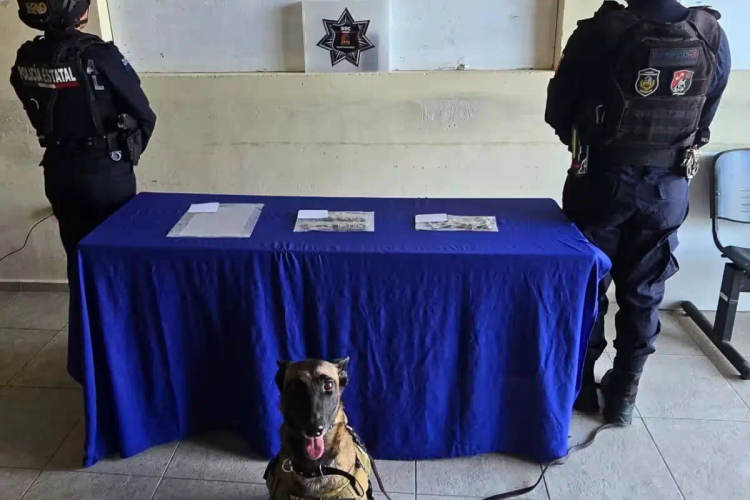
Behind the successful seizure of abandoned narcotics at Tulum’s busy ADO terminal this week was a single, highly trained specialist: Kira. A Belgian Malinois from the Grupo Canino K-9 of the Secretaría de Seguridad Ciudadana (SSC), Kira’s intervention transformed a routine preventive patrol into a significant tactical find, underscoring the indispensable role of biological precision in Quintana Roo’s regional security framework.
While navigating the high-traffic corridor of the terminal located on Avenida Tulum, Kira exhibited the tell-tale signs of a professional detector at work. Far from the aggressive demeanor sometimes associated with police dogs, her marking was subtle and surgical. As she passed the public restroom area, she shifted her trajectory, zeroing in on a trash receptacle with a physical alert that notified her human handler of a chemical anomaly.
The Binomio Canino and the Science of the Positive Marking
The success of these operations relies on the "binomio canino," the symbiotic relationship between a dog and their handler. For Kira, the discovery of abandoned substances was not a matter of chance but the culmination of rigorous training designed to identify specific volatile organic compounds. Her focus on the restroom area led to the recovery of 10 transparent bags containing marijuana and 12 individual wrappers of suspected drug-infused chocolates.
Training for a unit like Kira involves months of repetitive environmental conditioning. Belgian Malinois are chosen for these roles due to their high drive, intellectual agility, and physical stamina, traits that are essential for patrolling tropical transit hubs where heat and crowd noise can easily distract less disciplined animals. The "positive marking" she performed near the waste bin is the final step in a complex cognitive process where the dog filters out common scents like food waste and cleaning chemicals to find the illicit target.

Tactical Superiority in Soft Targets
Transit nodes like bus terminals are considered "soft targets" by security analysts because of the constant flow of people and the high degree of anonymity. In such environments, traditional physical searches of every traveler or piece of luggage are logistically impossible. This is where Kira’s tactical superiority becomes evident. A K-9 unit can scan dozens of individuals and lockers in the time it takes an officer to perform a single manual inspection.
The use of canine units at the ADO terminal provides a non-invasive yet highly effective layer of security. Kira’s ability to detect hidden substances within public infrastructure, where products are often abandoned to avoid direct possession during a search, forces distributors to alter their logistical patterns. The "abandonment" of the 10 bags of marijuana is seen by authorities as a direct result of the pressure exerted by the presence of a specialized unit like the Grupo Canino K-9.
Beyond Deterrence and the Public Health Angle
The discovery of 12 wrappers of suspected cannabinoid-infused chocolates highlights a growing concern for regional authorities. Unlike standard narcotics, these "edibles" are designed to be inconspicuous and mirror legitimate grocery products. This trend presents a dual threat: it facilitates the undetected movement of drugs through public spaces and creates a significant public health risk due to the lack of dosage control or sanitary oversight.
Kira’s specialized olfactory training is specifically adapted to identify these more elusive forms of narcotics. By detecting substances concealed within processed food packaging, she prevents unregulated psychoactive products from reaching the retail-level market where they could be accidentally consumed by high-risk populations. The removal of these chocolates from the ADO terminal is viewed as a victory for public safety as much as it is for law enforcement.


The Belgian Malinois as a Security Pillar in Quintana Roo
The Secretaría de Seguridad Ciudadana currently manages a specialized fleet of approximately 17 canines across the state, with the Belgian Malinois being a preferred breed. These animals are not treated as equipment but as members of the force, with strict protocols regarding their health, work hours, and retirement.
Kira’s work on Avenida Tulum is representative of the silent, daily labor of these units. From checking the perimeter of the Tulum National Park to monitoring the luggage bays of regional buses, the K-9 units provide a psychological and tactical deterrent that technology has yet to replicate. Their presence ensures that even in the absence of an immediate arrest, the infrastructure for distributing illicit goods remains under constant pressure.

Institutional Continuity and Future Operations
Following Kira’s alert, the seized materials were formally transferred to the Fiscalía General del Estado (FGE) to be integrated into an ongoing investigation. While the "no-detainee" result is a common outcome when narcotics are found in shared spaces, the institutional value of the seizure lies in the disruption of the supply chain.
As Tulum waits for the arrival of the Maya Train and the full integration of its new international airport, the K-9 units are expected to play an even larger role in transit safety. The SSC has signaled that specialized sweeps will remain a permanent feature of the city's transport architecture. For Kira and her fellow K-9 agents, the mission remains consistent: protecting the heartbeat of the Riviera Maya through the unparalleled precision of a single scent.
Should security protocols at regional bus terminals be further intensified, or is the current level of canine surveillance sufficient? Join the conversation and share your perspective with us on Instagram and Facebook at @thetulumtimes.

The Tulum Times · Newsletter
The story continues in your inbox.
Essential Tulum news and local insight, a few times a week. Free.
No spam. Unsubscribe anytime.
Transportation in Tulum: Taxi, Bus, Transfers, and Mobility
Taxi fares, buses, transfers, road changes, mobility updates, and practical transport guidance for Tulum.

“The best journalists reporting from paradise, highlighting the heroes that keep Tulum the most beautiful place in the world! THANK YOU!”