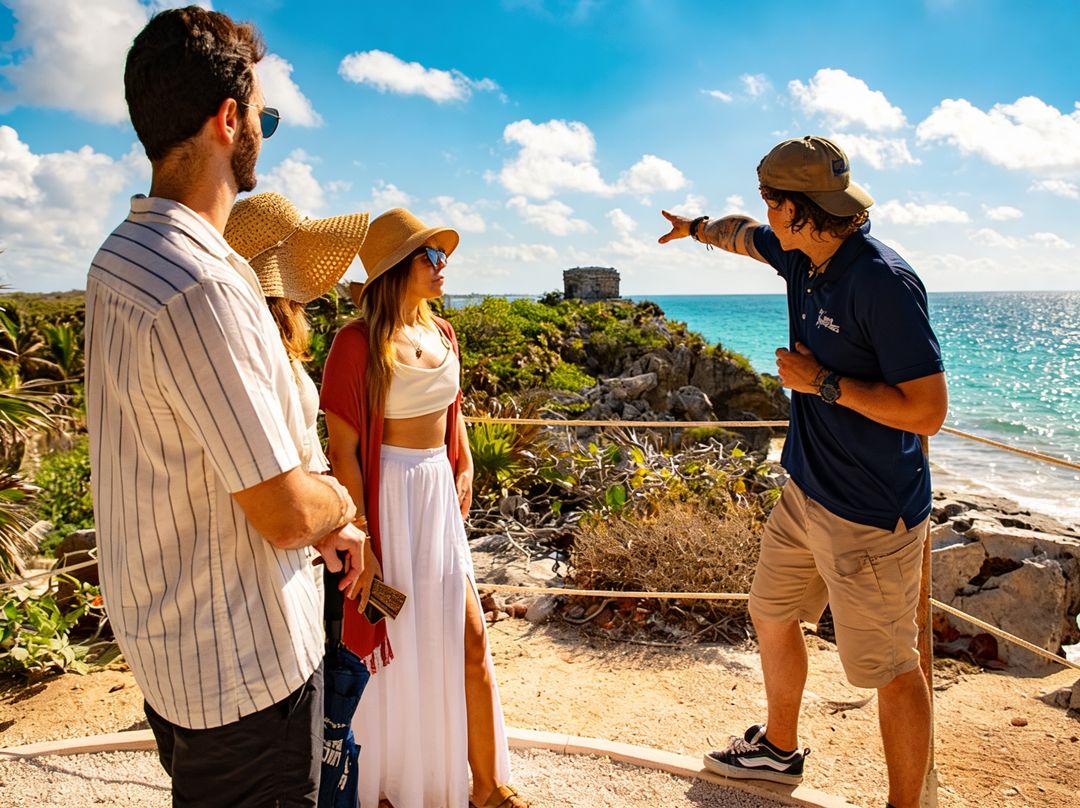
Professional tour guides at the Tulum Archaeological Zone guide services are navigating one of the most challenging high seasons in recent history, reporting an operational slump that has reduced local labor activity to just 40 to 50 percent of its traditional capacity. The figures, confirmed by Julio Villagómez Villalobos, Secretary General of the Tulum Guide Association, highlight a growing disconnect between the site’s physical visitor numbers and the economic health of the local workers who depend on the site's historical and cultural appeal. While the cliffside ruins remain a top national draw, the specific segment of travelers who hire professional guides is in rapid retreat, signaling a structural shift in the destination's tourism model.
The current crisis represents more than a seasonal dip; it is a symptom of a decoupling economy where rising foot traffic no longer translates into direct revenue for independent service providers. According to Villagómez, the decline is most pronounced among independent travelers, the demographic that has historically provided the backbone of the local guide economy through the booking of personalized, high-value tours. As this segment evaporates, the guides who rely on direct, on-site hiring find themselves sidelined by a tourism market that is increasingly moving toward "closed packages" and centralized operations that bypass local labor.
The Paradox of Stable Visitation for Tulum Archaeological Zone Guide Services
The most striking aspect of the 2026 season is the visual contradiction at the gates of the ancient walled city. Visitor flow into the Tulum Archaeological Zone has remained at levels that authorities describe as "acceptable," with daily entries frequently reaching into the thousands during peak hours. However, the conversion rate from visitor to client for local guides has plummeted. This paradox suggests that while people are still coming to see the iconic Castillo and the Temple of the Frescoes, they are doing so with a drastically reduced appetite for the added value of professional interpretation.
Villagómez notes that the "independent explorer," the traveler who arrives without a pre-booked itinerary and seeks to engage with the local community, is becoming a rarity. This shift is partly a result of the changing traveler profile in the Mexican Caribbean, which is skewing more toward visitors staying in all-inclusive resorts in Akumal or the northern Riviera Maya. These travelers often arrive on large, pre-arranged buses where tours are either included in the package or handled by large-scale international agencies, leaving the unionized guides of Tulum with a dwindling pool of potential customers.

Compounding Deterrents to Tulum Archaeological Zone Guide Services
The decline in Tulum Archaeological Zone guide services is not an isolated phenomenon but the result of a "perfect storm" of negative factors that have eroded Tulum’s competitiveness. Villagómez identified a combination of global economic pressures and local logistical failures that are actively desincentivizing the independent traveler. Among these, the persistent arrival of sargassum remains a significant psychological barrier. Even for a site like the ruins, where the beach is often a secondary attraction, the sight of seaweed-choked shores and the associated odors can diminish the perceived value of a premium guided experience.
Furthermore, the perception of insecurity continues to cast a shadow over the destination. While the Archaeological Zone itself is heavily guarded by federal forces and the National Guard, the surrounding urban environment and the headlines generated by regional incidents create a climate of caution. For many travelers, this caution translates into a desire to stay within the "bubble" of their resort or a pre-vetted tour group, rather than navigating the local town or engaging with independent service providers at the site's entrance.
The Cost Trap Affecting Tulum Archaeological Zone Guide Services
Perhaps the most damaging factor identified by the guide leadership is the rising volume of complaints regarding excessive costs in basic services. Villagómez pointed directly to the "cobros excesivos" (excessive charges) in the restaurant and transportation sectors as a primary driver of the guide crisis. When a visitor pays a premium for a taxi from the downtown area or experiences "sticker shock" at a local eatery, their discretionary budget for the rest of the day, including cultural tours, is immediately constrained.
"The image of Tulum is being affected by these practices," Villagómez warned. The destination is increasingly developing a reputation for being overpriced, a sentiment that is widely shared on travel forums and social media. This reputation acts as a filter that repels the middle-market independent traveler who values authenticity and fair pricing. As these visitors opt for other regional destinations or stay within the predictable cost environment of an all-inclusive hotel, the local guide becomes an "optional luxury" that many decide to skip.

Structural Coordination for Tulum Archaeological Zone Guide Services
The survival of independent professional guides is intrinsically linked to the health of the entire local tourism ecosystem. Villagómez has called for urgent coordination between municipal authorities, the federal government, and the private sector to protect the "motor" of the local economy. This coordination would involve not only more aggressive sargassum management and security protocols but also a concerted effort to regulate the pricing abuses that are tarnishing the brand of Tulum.
Without a strategic intervention to improve the overall visitor experience and restore the destination's value proposition, the guide industry faces a permanent downsizing. The guides, many of whom have spent decades studying the history and archaeology of the Maya civilization, represent a vital part of the destination’s cultural capital. Their marginalization in favor of mass-market, "fast tourism" packages would be a significant loss for the quality of the Tulum experience.
Future Outlook for Tulum Archaeological Zone Guide Services
As the spring high season draws to a close, the outlook for the summer months remains fragile. The 40 to 50 percent operational level is a difficult threshold for many families to sustain, especially in an environment where the cost of living in Tulum continues to rise alongside tourism prices. The leadership of the guides remains hopeful that a stabilization of the destination’s image and a return of the independent traveler could provide a much-needed boost, but they acknowledge that the path to recovery requires more than just hope.
The crisis of the tour guides is a warning for all of Tulum. It serves as a reminder that a destination cannot thrive on volume alone if the local community is being priced out of the benefits. Restoring the balance between visitation and local economic participation is the only way to ensure that the ancient city of Tulum remains not just a beautiful backdrop for a photograph, but a living workplace for the people who know its stories best.
How can Tulum restore the balance between rising tourism volume and the economic survival of local independent guides? Join the conversation and share your thoughts with us on Instagram and Facebook at @thetulumtimes.
Contact the Editor: editorial@tulumtimes.com

The Tulum Times · Newsletter
The story continues in your inbox.
Essential Tulum news and local insight, a few times a week. Free.
No spam. Unsubscribe anytime.
Transportation in Tulum: Taxi, Bus, Transfers, and Mobility
Taxi fares, buses, transfers, road changes, mobility updates, and practical transport guidance for Tulum.

“The best journalists reporting from paradise, highlighting the heroes that keep Tulum the most beautiful place in the world! THANK YOU!”