


For a municipality that has attracted billions in tourism investment over the past decade, Tulum has operated with a surprising gap in its urban fabric: no major commercial plaza. Residents who need a supermarket run, a gym, a movie, or a chain restaurant have consistently had to travel to Playa del Carmen or Cancún to find them. That is the reality that Centro Tulum is about to end.
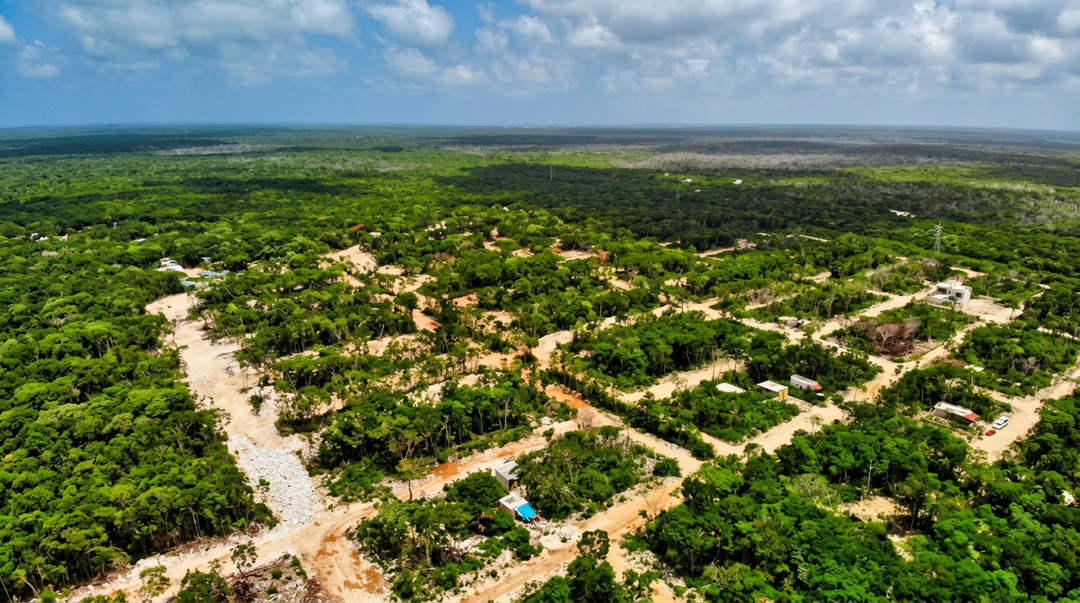
Municipal President Diego Castañón Trejo conducted a formal supervision visit to the Centro Tulum site this past weekend, confirming that construction is advancing and that the first commercial plaza in the city's history will soon be ready to open. The project, located on the Cancún-Chetumal federal highway adjacent to the city center, is a 60-unit retail development with confirmed anchor tenants that include some of Mexico's most recognized brands, a projected employment footprint of 900 direct and indirect jobs, and a design intended to serve both the local population and the tourist traffic that flows through the municipality year-round.
A Project Three Years in the Making
Centro Tulum has been in development since the early years of Tulum's elevated status as a municipality. Originally scheduled for a 2023 opening, the project encountered the delays common to large-scale construction in a destination still building its own infrastructure. With the supervision visit now confirmed, sources tracking the project indicate an opening in the first half of 2026 — a projection consistent with the construction progress visible on site.
What has held steady throughout those years is the tenant lineup. Cinépolis will operate the complex's cinema, becoming the first movie theater in Tulum's history. Chedraui will anchor the grocery and household goods segment — a critical service for a city where residents currently drive 90 minutes to Playa del Carmen for a full supermarket shop. Smart Fit brings a premium gym experience. Starbucks, Toks, and Domino's round out the food and beverage offer. Promoda and Coppel address fashion and consumer credit, respectively. Several sources also indicate iShop and BBVA among the confirmed tenants, covering electronics retail and personal banking — two services that have long been underrepresented in Tulum's commercial landscape.

What the Mayor Said — and What He Didn't
During the supervision visit, Castañón Trejo framed Centro Tulum as an expression of investor confidence in his administration. "Today we find ourselves in what will be our first commercial plaza, Centro Tulum — a space that represents the growth, the vision, and the dynamism of our municipality," he told those present. He pointed to job creation and service expansion as the primary benchmarks for success, and described the project as evidence that Tulum is maturing from a tourist destination into a city capable of sustaining its own population.
What the mayor's statement left implied, rather than stated, is equally significant. Tulum's population has grown faster than its public services. The city that now draws international tourists to its cenotes and jungle hotels also contains neighborhoods without reliable water service, informal markets, and a working class that earns tourism wages while being priced out of tourism real estate. A commercial plaza with 900 jobs and an accessible grocery anchor does not resolve those structural pressures — but it addresses one of the most concrete gaps in daily service availability for the people who actually live here.
Castañón Trejo acknowledged the employment dimension directly. "This doesn't just mean investment. It also drives job creation and opens new opportunities for Tulum families," he said. With 60 commercial units, the labor impact extends beyond the anchor tenants to the small and medium operators who will occupy the remaining storefronts — local entrepreneurs who will have, for the first time, a structured commercial environment with consistent foot traffic.

Context: Why This Matters in 2026
The timing of Centro Tulum's opening is not incidental. The new Tulum International Airport, operational since December 2023, has already increased the volume of direct arrivals to the municipality and shifted the commercial center of gravity southward. The Maya Train, connecting Tulum to the broader Yucatán Peninsula since late 2023, has further accelerated that dynamic. The infrastructure is in place to support a commercial destination. What has been missing is the commercial destination itself.

Centro Tulum is the first major response to that gap in the private sector. Its location on the Cancún-Chetumal highway — the main arterial connecting Tulum to both the airport and the city center — positions it to capture traffic from multiple directions: residents from the urban core, workers from the hotel zone, visitors in transit, and day-trippers from nearby communities like Akumal, Tankah, and Felipe Carrillo Puerto.
The anchor tenant mix is calibrated for this dual audience. Cinépolis and Smart Fit cater primarily to local residents seeking services that require committed infrastructure. Chedraui operates at a price point accessible to working families. Starbucks and Toks are positioned for the aspirational middle class and for tourists looking for familiar international brands within the destination. Together, they signal a commercial thesis: Tulum can sustain a mixed-use retail environment precisely because its visitor and resident populations, while socioeconomically distinct, have overlapping consumption patterns.

What 900 Jobs Actually Mean Here
The number 900 requires context. Tulum's formal employment base is disproportionately concentrated in tourism and hospitality sectors characterized by seasonal volatility, informal contracts, and limited career trajectories. Commercial retail employment, while not uniformly better compensated, offers year-round stability, fixed schedules, and in the case of anchor tenants like Chedraui and Cinépolis, access to benefits and formal labor registration.
For a community where a large segment of the working population migrates seasonally to follow tourism demand, 900 stable positions are structurally significant — not transformative at scale, but meaningful at the household level. The projection also accounts for indirect employment: security, logistics, cleaning, maintenance, and the ancillary services that a complex of this size generates in its immediate surroundings.
Mayor Castañón Trejo closed his remarks with a phrase that read simultaneously as a campaign slogan and a genuine conviction: "When development is done with vision, Tulum advances." Whether Centro Tulum delivers on that vision will depend less on the ribbon-cutting and more on whether its operational model — pricing, accessibility, local hiring practices — actually serves the community it claims to represent.
For now, the supervision visit is a confirmation that the project is real, the timeline is closing in, and Tulum is about to get something it has needed for years: a commercial infrastructure worthy of the city it is becoming.
Is Centro Tulum the development Tulum residents have been waiting for, or does the city still need more? Share your take with us on Instagram and Facebook at @TulumTimes.

The Tulum Times · Newsletter
The story continues in your inbox.
Essential Tulum news and local insight, a few times a week. Free.
No spam. Unsubscribe anytime.
Tulum Development, Permits, and Construction Watch
Reporting on permits, construction, regulation, and major development decisions shaping Tulum’s urban growth and investment climate.

“The best journalists reporting from paradise, highlighting the heroes that keep Tulum the most beautiful place in the world! THANK YOU!”


