
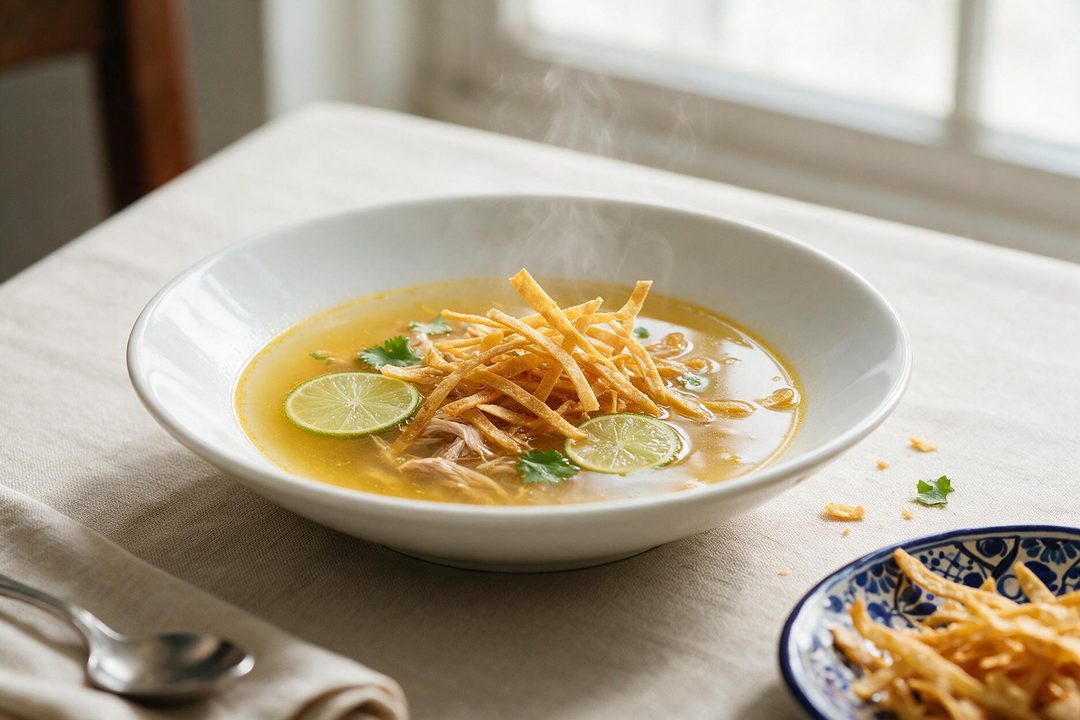
Sopa de lima belongs to Yucatán, not to Tulum, and it does not travel well in name. The lima in question is lima agria, a knobbly, thin-skinned citrus with a green-yellow rind and a flavour that sits somewhere between lime, grapefruit and something faintly floral. It is sour, but the sourness has a bitter edge that regular Persian lime never gives. In the markets of Mérida and Valladolid it is sold loose by the kilo, and in Tulum you can usually find it at the Friday market or in the small fruit shops off the highway, though not every week.
The broth underneath it is turkey in the older version and chicken in most kitchens now. Turkey is what appears at weddings, novenas and the days around Christmas, when a bird is already being cooked for something else and the carcass goes into the pot. The seasoning is restrained: toasted Mexican oregano, allspice, a couple of cloves, black pepper, garlic, onion. There is a light sofrito of tomato, onion and sweet chile, usually x'catic, but the soup should stay clear enough to see the shredded meat at the bottom of the bowl.
What people get wrong is the lime. Squeezing a lot of juice into a hot pot and letting it boil turns the soup flat and metallic. The juice goes in off the heat, at the end, and the classic trick is to char one half of a lima on a dry comal and drop it into the pot for a few minutes so the oils in the peel perfume the broth without leaching bitterness. Leave a whole lima simmering for half an hour and you get a soup nobody wants to finish.
The tortilla strips are not a garnish you can skip. They are fried until properly hard, added to the bowl just before the broth so they soften unevenly, some pieces still snapping and some gone soft. Habanero goes on the table, not in the pot. Served hot at midday, it is a light meal in a place where light meals matter, and it is one of the few soups people here will eat in May.
Ingredients
21 items · for 6For the broth
- 1.5 kg bone-in chicken pieces, or 1.2 kg turkey thighs and drumsticks
- 3 litres cold water (12 cups)
- 1 white onion, halved
- 1 whole head of garlic, halved across the middle, skin on
- 6 black peppercorns
- 4 allspice berries
- 2 cloves
- 1 tsp dried Mexican oregano
- 2 tsp salt, plus more to finish
For the sofrito
- 2 tbsp lard or neutral oil
- 1 white onion, finely chopped
- 1 x'catic chile or 1 green bell pepper, seeded and finely chopped
- 2 medium tomatoes (about 300 g), finely chopped
- 1 tsp dried Mexican oregano, toasted and crumbled
- 1/4 tsp ground allspice
To finish and serve
- 4 limas agrias (about 60 ml juice, 4 tbsp), plus 1 extra for charring
- 8 corn tortillas, day-old, cut into 5 mm strips
- 250 ml neutral oil for frying (1 cup)
- 1 habanero chile, whole or sliced, to serve
- A small handful of coriander leaves, chopped
- Lime wedges to serve
Step by step
9 stepsStart the broth
Put the chicken or turkey in a large pot with the cold water, halved onion and halved head of garlic. Bring slowly to a bare simmer and skim off the grey foam that rises in the first ten minutes. Do not let it boil hard or the broth will cloud.
Toast the spices
While the pot comes up, toast the peppercorns, allspice, cloves and the first teaspoon of oregano in a dry pan over medium heat for about a minute, until the oregano smells sharp and the spices are fragrant. Tip them into the pot with the 2 tsp salt.
Simmer until tender
Keep the broth at a lazy simmer, barely moving, for 45 minutes for chicken or about 90 minutes for turkey. The meat is ready when it pulls cleanly from the bone. Lift the meat out onto a plate and strain the broth through a sieve into a clean pot. You should have around 2.5 litres.
Shred the meat
When the meat is cool enough to handle, discard skin and bones and pull the flesh into rough shreds with your fingers. Do not chop it. Set it aside and cover so it does not dry out.
Fry the tortilla strips
Heat the oil in a small deep pan to about 180C. Fry the tortilla strips in three or four batches, turning once, for 1 to 2 minutes each until they are pale gold and rigid. Drain on paper and salt them lightly while hot. They should snap, not bend.
Make the sofrito
In the pan you will finish the soup in, heat the lard over medium heat and cook the chopped onion and chile with a pinch of salt for 6 to 8 minutes until soft and translucent but not browned. Add the tomato, the toasted oregano and the ground allspice and cook another 5 minutes, until the tomato has collapsed and the mixture smells sweet rather than raw.
Bring it together
Pour the strained broth into the sofrito, add the shredded meat and simmer gently for 10 minutes. Taste for salt now, before any citrus goes in, and correct it. The broth should taste complete and slightly under-seasoned for sourness.
Char and add the lima
Cut the extra lima in half and lay it cut side down on a dry comal or heavy pan over high heat until the flesh is properly blackened, about 2 minutes. Drop one charred half into the pot, turn off the heat and let it sit for 5 minutes, then remove it. Juice the remaining limas and stir in 60 ml off the heat. Add more juice a tablespoon at a time until the soup is clearly sour but the broth still tastes of poultry.
Serve
Put a generous handful of tortilla strips in the base of each warm bowl, ladle the hot soup over them, and scatter with coriander. Habanero, extra strips and lime wedges go on the table. Eat straight away, while some of the strips are still crisp.
Notes from the kitchen
- Outside Mexico, lima agria is hard to find. The usual working substitute is three parts Key lime or Persian lime juice to one part grapefruit juice, with a strip of grapefruit peel charred and steeped in the pot for five minutes in place of the charred lima half.
- Never let the soup boil after the juice goes in. If you are reheating leftovers, warm the broth gently and add a squeeze of fresh juice at the end to wake it back up.
- The broth and shredded meat keep three days in the fridge and freeze well for a month. Fry the tortilla strips the day you serve, or they go leathery.
- If you are cooking a turkey for another meal, the carcass and neck make a better broth than chicken. Simmer them for two hours with the same aromatics and use 1 kg of separately poached chicken thighs for the meat.
This is the standard Yucatecan household version, built on chicken with a turkey option, as it is cooked across the peninsula rather than in any one kitchen.
This photograph was generated with artificial intelligence and may differ from the finished dish.