
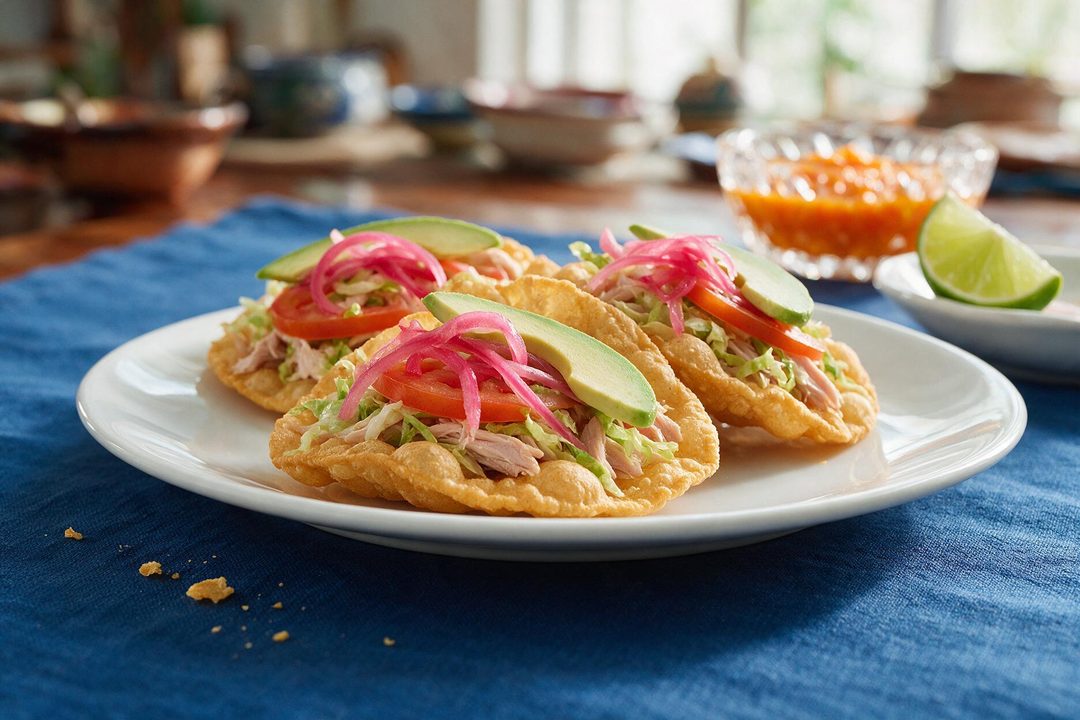
Salbutes belong to the evening in Yucatán. They appear at loncherías and plaza stands once the heat has dropped, sold by the piece alongside panuchos, and they are the thing people order two or three of while deciding whether to order more. They also turn up at family parties and at long Sunday lunches, usually on the same platter as their bean-filled cousin so everyone can take what they prefer.
The construction is simple: a small round of corn masa, pressed thin, dropped into hot fat and pushed under the surface until it inflates. The puff is steam. A moment later the round is lifted out, still soft and pliable rather than brittle, and piled with shredded turkey or chicken, shredded cabbage or lettuce, tomato, avocado and a fistful of red onion pickled in sour orange. Habanero goes on the table, not on the salbute, so each person decides.
The difference between a salbute and a panucho is the bean. A panucho is split after frying and filled with refried black bean paste, which makes it denser and slightly sweeter. A salbute is left hollow, which makes it lighter and lets the fat and the masa taste of themselves. Turkey is the older topping and still the better one if you can get it, since the poaching broth is used to keep the meat moist.
What people get wrong is texture. A salbute is not a tostada and it is not a chalupa. It should give when you bite it, with a thin crisp shell over a soft interior, which means it has to be eaten within a few minutes of leaving the oil. The other common error is letting the pressed rounds sit and dry out before frying. A dry surface will not puff. Press and fry in the same movement, one or two at a time, and accept that the cook eats last.
Ingredients
22 items · for 6For the meat
- 1 kg turkey thigh or chicken thighs, bone in, skin on
- 1/2 white onion, halved again
- 3 cloves garlic, peeled
- 1 tsp dried Mexican oregano
- 1 bay leaf
- 2 tsp salt
- 1.5 litres water (6 cups)
For the pickled onion
- 2 medium red onions, sliced thin (about 350 g)
- 180 ml sour orange juice (3/4 cup), or 120 ml lime juice plus 60 ml orange juice
- 1 tsp salt
- 1/2 tsp dried Mexican oregano, crumbled
- 1 habanero, whole and pierced once (optional)
For the salbutes
- 750 g fresh nixtamalized masa, or 500 g masa harina plus about 400 ml warm water
- 1 tsp salt
- 2 tbsp plain wheat flour (optional, helps them stay tender)
- 1 tbsp lard, softened (optional)
- 800 ml lard or neutral oil for frying, enough for 3 cm depth
To serve
- 1/4 small cabbage, shredded fine, or 1 head romaine lettuce, shredded
- 2 tomatoes, sliced thin
- 2 avocados, sliced
- 1 habanero, finely chopped, for the table
- Lime wedges
Step by step
7 stepsPoach the meat
Put the turkey or chicken in a pot with the onion, garlic, oregano, bay leaf, salt and water. Bring to a simmer, skim the grey foam that rises in the first five minutes, then cook uncovered at a low simmer for 45 minutes for chicken or up to 70 minutes for turkey, until the meat pulls away from the bone with no resistance. Leave it to cool in the broth for 20 minutes before handling.
Pickle the onion
While the meat cooks, put the sliced onion in a bowl, pour boiling water over it, count to ten, then drain. Toss with the sour orange juice, salt, oregano and the pierced habanero if using. Leave at room temperature for at least 30 minutes. The onion goes from purple to bright pink and softens without losing its bite. It keeps a week refrigerated.
Shred and moisten
Pull the meat off the bones and shred it with your fingers into pieces roughly the size of your little finger. Discard skin and bones. Moisten the shredded meat with four or five tablespoons of the strained poaching broth so it does not dry out sitting on the plate, and check the salt. Keep it warm.
Mix the masa
If using masa harina, mix it with the salt and the optional flour, then work in the warm water a little at a time until you have a soft, cohesive dough. Fresh masa needs only the salt, the optional flour and a splash of water. Work in the lard if using. The dough should feel like fresh plasticine: a pressed ball should not crack at the edges. If it does, add water a spoonful at a time. Cover with a damp cloth.
Heat the fat
Pour the lard or oil into a deep frying pan or small wok to a depth of about 3 cm and bring it to 180C. A pinch of masa dropped in should sizzle hard and rise within two seconds. Set a rack or a plate lined with paper next to the stove. Get the toppings within arm's reach before you start frying, because assembly happens fast.
Press and fry
Roll a ball of dough about 35 g, the size of a small plum, and press it between two sheets of plastic in a tortilla press to about 10 cm across and 3 mm thick, slightly thicker than a tortilla. Slide it straight into the fat. Spoon hot fat over the top or hold it under with a slotted spoon and it will balloon within 20 seconds. Fry about 45 seconds a side, until pale gold and blistered but still flexible. Drain and repeat, two at a time at most. Press each round only when you are ready to fry it.
Assemble and eat
Lay each salbute puffed side up. Top with a little shredded cabbage or lettuce, a generous pinch of the moistened meat, a slice of tomato, a slice of avocado and a tangle of pickled onion. Serve at once with chopped habanero and lime on the table. They are meant to be eaten in two or three bites, standing up if necessary.
Notes from the kitchen
- Outside Mexico, use Maseca or another nixtamalized corn flour, not polenta or cornmeal, which will not hold together. Sour orange can be replaced with two parts lime juice to one part orange juice.
- Lard gives the right flavour and is what most cooks here use. Vegetable oil works and reheats better if you are frying in batches.
- The meat and the pickled onion can both be made a day ahead and improve overnight. The masa can be mixed a few hours ahead if kept under a damp cloth.
- Fried salbutes do not keep. If a round fails to puff, use it anyway as a flat base, or split it and fill it with refried black beans, which makes it a panucho.
This is the standard household and lonchería version served across the Yucatán peninsula, with turkey given as the older choice and chicken as the everyday one.
This photograph was generated with artificial intelligence and may differ from the finished dish.