
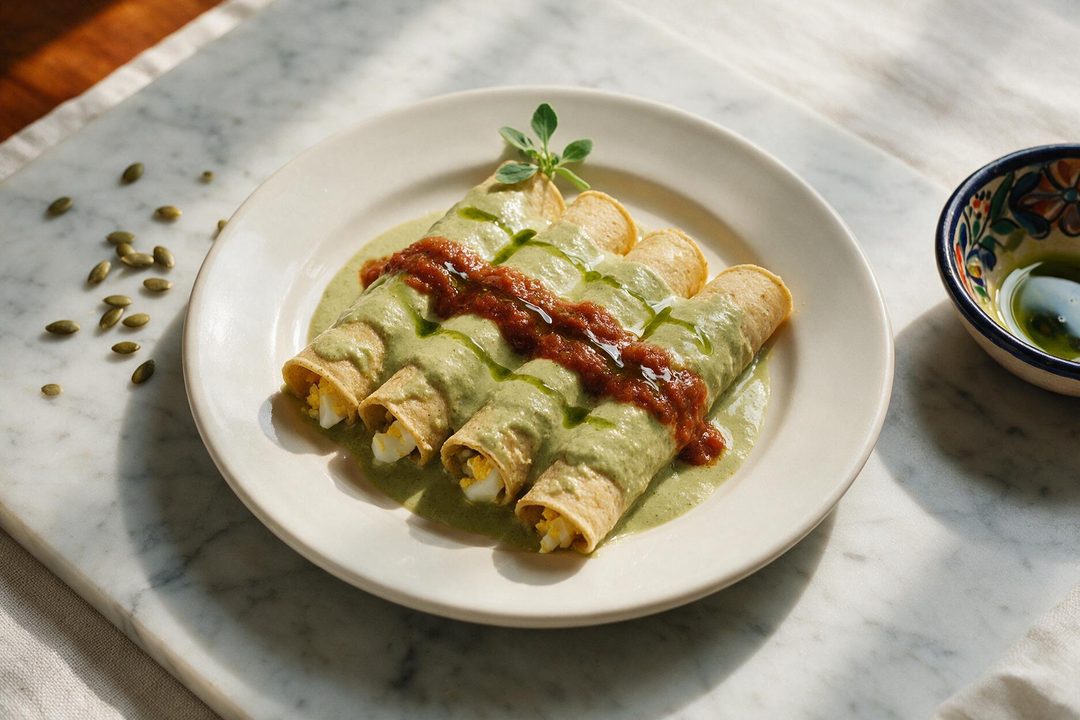
Papadzules are one of the oldest things still cooked regularly in Yucatecan kitchens. The whole plate comes from three ingredients that were here long before anyone arrived with a pig or a cow: corn, squash seeds and tomatoes. The egg is the one part that came later, and it slipped in so early that nobody thinks of it as an addition. The name is Yucatec Maya. It is often glossed as food for the lords, though that reading is argued over, and the more careful answer is that we do not know for certain.
The sauce is the dish. Pumpkin seeds are toasted dry, ground fine, then worked with warm water that has had epazote boiled in it. As you knead the paste, a green oil separates out and rises. That oil is not waste and it is not skimmed away for tidiness. It is saved and spooned over the finished rolls, which is why a proper plate of papadzules has a slick of dark green on top of the red tomato. Without it the dish looks flat and tastes flat.
You find papadzules at midday, in market fondas and at home, and they turn up at family gatherings where a large tray can be assembled ahead and covered. The flavour is soft and quite gentle: nutty from the seeds, faintly resinous from the epazote, sweet and slightly smoky from the roasted tomato, with the habanero sitting behind it all rather than in front. It is filling without being heavy. Cold beer or a cold hibiscus water both work.
Two things go wrong. The first is toasting the seeds too hard. They need heat only until they swell and smell like popcorn, no colour to speak of, because scorched seeds make a bitter grey sauce that nothing will fix. The second is boiling the pumpkin seed sauce. It is not a sauce you simmer. Heat it gently, keep it at the temperature of a hot bath, and if it splits or turns grainy you have taken it too far. Salted, oil-roasted snacking pepitas are the third mistake, and the least forgivable, because the salt cannot be taken back out.
Ingredients
12 items · for 6For the pumpkin seed sauce
- 400 g raw hulled pumpkin seeds, unsalted (about 3 cups)
- 1.2 litres water (5 cups)
- 1 large bunch fresh epazote, about 20 g
- 1 teaspoon fine salt, plus more to taste
For the tomato sauce (chiltomate)
- 1 kg ripe roma tomatoes
- 1 small white onion, halved
- 1 whole habanero chilli
- 1 tablespoon lard or neutral oil
- Salt
To assemble
- 9 eggs
- 18 corn tortillas, 12 to 14 cm
- A few epazote leaves for the plate, optional
Step by step
9 stepsBoil the epazote water
Bring the 1.2 litres of water to the boil with the salt and the whole bunch of epazote, stems and all. Boil for 5 minutes, then turn off the heat and leave it to sit. The water should smell strongly herbal and be lightly tinted green. Keep it warm; you will use it hot but not boiling. Fish out the epazote before you start on the sauce and reserve a little for the plate if you like.
Toast the pumpkin seeds
Set a heavy dry pan over medium heat and toast the seeds in two or three batches, stirring constantly. They will begin to puff and pop within two or three minutes and will smell like popcorn. Pull them off at that point, while they are still pale. Any brown edges mean bitterness in the finished sauce. Tip each batch onto a tray to cool completely.
Grind to a fine flour
Grind the cooled seeds in batches in a blender or spice grinder until you have a damp, fine meal that holds together when pressed. This takes longer than you expect, and you should stop and shake the jar so the oily paste at the bottom does not gum up. Do not run it so long that it becomes butter.
Knead out the green oil
Put the ground seeds in a wide bowl and add about 250 ml of the hot epazote water. Knead with your fingers into a smooth stiff paste, pressing and squeezing for three or four minutes. A dark green oil will bead up and pool. Tilt the bowl and spoon that oil into a small cup, then knead again with another splash of water and collect any more that comes out. Expect three to five tablespoons in total.
Loosen the sauce
Add the remaining hot epazote water to the paste a cup at a time, whisking or stirring until smooth. Aim for the consistency of thin cream, loose enough to coat a tortilla and run off it. Taste and salt properly, since a bland pumpkin seed sauce tastes of nothing. Keep it in a wide bowl or a pan over the lowest possible heat. It must stay warm and must never simmer, or it will turn grainy and split.
Make the chiltomate
Char the tomatoes, onion and habanero directly on a comal or in a dry pan until blistered and blackened in patches and soft to the point of collapse, about 12 minutes, turning them. Remove the habanero and set it aside. Blend the tomatoes and onion, skins and all, to a rough sauce. Heat the lard in a pan, pour in the sauce, add the whole habanero, and cook at a lively simmer for 10 minutes until it darkens and thickens slightly. Salt it. Take the habanero out before serving, or leave it in if the table wants heat.
Boil and chop the eggs
Cover the eggs with cold water, bring to the boil, then cook for 10 minutes. Cool them under running water, peel and chop coarsely. Season with a pinch of salt. The pieces should be visible in the roll, not mashed to a paste.
Dip, fill and roll
Warm the tortillas on the comal until soft and pliable, and keep them wrapped in a cloth. Working one at a time, lay a tortilla in the warm pumpkin seed sauce for a couple of seconds a side so it is coated but not falling apart, lift it onto the plate, spoon a line of chopped egg down the middle and roll it up. Three per plate, laid seam down and side by side.
Sauce and serve
Spoon more pumpkin seed sauce over the rolls, then a ribbon of chiltomate across the middle, then drizzle the reserved green oil over the top. Add a leaf or two of epazote. Serve straight away while everything is warm; papadzules do not improve with sitting.
Notes from the kitchen
- Outside Mexico, buy raw unsalted hulled pumpkin seeds from a health food shop or a Middle Eastern grocer, not the oil-roasted salted kind sold as a snack. Some cooks here use small whole seeds with the hull on, ground as they are, which gives a slightly darker sauce.
- Dried epazote works if fresh is not available: use 2 tablespoons in the water and strain it well. Without epazote at all, the sauce is still good, just less distinctive. Coriander is not a substitute; it pulls the dish somewhere else entirely.
- If the sauce splits or thickens too much, take it off the heat and whisk in a little hot water. If it has gone grainy from overheating, blend it briefly and accept a slightly rougher texture.
- The chiltomate and the boiled eggs can be made a day ahead. Make the pumpkin seed sauce the same day and assemble at the last minute, as it stiffens and the tortillas go soggy on standing.
This is the standard household version cooked across the peninsula, with the green oil reserved and returned to the plate as older cooks here insist on.
This photograph was generated with artificial intelligence and may differ from the finished dish.