
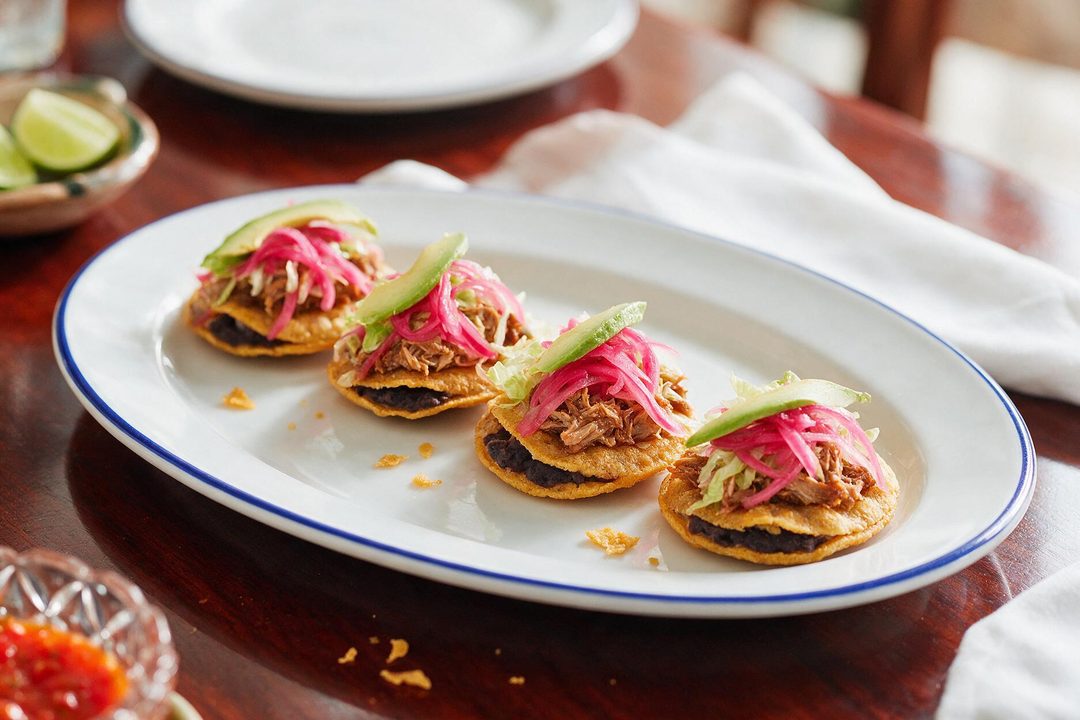
Panuchos are one of the two great evening antojitos of the Yucatan peninsula, the other being salbutes. Both are fried masa discs with meat and pickled onion on top. The difference, and it is the whole point, is that a panucho has a pocket of black bean paste sealed inside it before it goes into the fat. That thin layer of beans steams as the tortilla fries, so the finished thing is crisp on the outside and soft and dark in the middle. A salbut has no beans and puffs up hollow. People outside the region use the words interchangeably, which locals find odd in the way you would find it odd if someone called a crumpet a pancake.
The pocket comes from the tortilla itself. A well made tortilla, pressed thin and cooked on a hot comal, inflates on the second turn, and the top skin separates from the bottom. While it is still warm you slit the edge with a knife and open it like an envelope. That is the panucho. Nothing is glued or folded. If your tortillas refuse to puff, the masa was too dry or the comal was not hot enough, and the whole recipe stalls there, which is why it is worth pressing a few practice ones before you commit.
In Merida, Valladolid and here in Tulum they are food for the end of the day. Stands set up in the plazas after dark, and the standard order is a mixed plate of panuchos and salbutes with a bottle of something cold. Turkey is the traditional topping, simmered plain with onion and oregano and pulled into shreds, though cochinita pibil has become just as common and is what most visitors are served. On top go pickled red onions, a little shredded cabbage or lettuce, tomato, sometimes avocado, and habanero on the side for whoever wants it.
The taste is layered rather than loud: sweet fried corn, the mineral heaviness of the beans, meat that is savoury but not spiced hard, then the sour onions cutting through all of it. The onions are not a garnish. Without their acid the panucho reads as heavy and one note. The other common mistake is frying too long. You want the base crisp and the surface set, not a cracker. Thirty to forty seconds a side in hot fat is usually enough.
Ingredients
25 items · for 6For the pickled red onion
- 2 large red onions, sliced thin
- 180 ml sour orange juice (naranja agria), or 120 ml lime juice plus 60 ml orange juice
- 1 teaspoon dried Mexican oregano, toasted in a dry pan
- 1 teaspoon fine salt
- 1 habanero chilli, pierced once with a knife (optional)
For the turkey topping
- 800 g turkey thigh or leg, bone in (chicken thighs work as a substitute)
- 1/2 white onion, halved
- 3 garlic cloves, peeled
- 1 teaspoon dried Mexican oregano
- 6 black peppercorns
- 1.5 litres water
- 2 teaspoons salt
For the black bean paste
- 250 g dried black beans, or 2 x 400 g tins, drained
- 1/4 white onion
- 2 garlic cloves
- 2 sprigs epazote, if you can get it
- 1 tablespoon lard or vegetable oil
- salt to taste
For the tortillas
- 500 g masa harina for tortillas, plus 700 ml warm water, or 1 kg fresh nixtamalised masa
- 1/2 teaspoon salt
- 500 ml lard or neutral oil, for shallow frying
To serve
- 1/4 white cabbage or 1 small lettuce, shredded fine
- 2 tomatoes, sliced thin
- 1 avocado, sliced
- habanero salsa or sliced habanero, on the side
Step by step
9 stepsPickle the onions
Put the sliced onion in a heatproof bowl, cover with boiling water, count to thirty, then drain well. This takes the raw bite out without cooking them soft. Return to the bowl with the sour orange juice, oregano, salt and the pierced habanero if using. Press down so the liquid covers most of the onion. Leave at least an hour at room temperature. They turn bright pink and improve overnight in the fridge, where they keep two weeks.
Simmer the turkey
Put the turkey in a pot with the onion, garlic, oregano, peppercorns, water and salt. Bring to a boil, skim the grey foam off the top, then drop to a bare simmer and cook uncovered for 60 to 75 minutes, until the meat pulls away from the bone with no resistance. Let it cool in its broth, then shred by hand, discarding skin and bone. Moisten the shredded meat with a few spoons of the broth so it does not dry out while you fry.
Cook the beans
If using dried beans, rinse them and simmer with the onion, garlic and epazote in water to cover by five centimetres, topping up as needed, for 90 minutes to two hours until completely soft. Salt only in the last fifteen minutes. Drain, keeping the cooking liquid. Tinned beans need only a ten minute simmer with the aromatics.
Make the bean paste
Discard the onion and garlic. Blend or mash the beans with just enough cooking liquid to make a stiff purée. Heat the lard in a frying pan, add the purée and cook over medium heat, stirring, for five to eight minutes until it thickens into a paste that holds a line when you draw a spoon through it. It must be spreadable but not runny, or it will leak out of the tortillas. Season and set aside to cool slightly.
Mix and press the tortillas
Mix the masa harina with the salt and warm water, kneading for two minutes into a smooth dough with the feel of soft modelling clay. Rest it fifteen minutes covered with a damp cloth. If it cracks at the edge when you flatten a ball in your palm, work in more water a spoon at a time. Divide into 18 balls of about 45 g. Press each between two sheets of plastic in a tortilla press, or under a flat pan, to a thin round of roughly 12 cm.
Puff them on the comal
Heat a comal or heavy dry pan until a drop of water skitters across it. Cook a tortilla 40 seconds on the first side, turn it, give it another 40 seconds, then turn it back. It should inflate within seconds. Move it to a cloth and, while still hot, run a paring knife around one third of the edge and lift the top skin to open a pocket. Work in batches. Some will refuse to puff, so press a couple of spares.
Fill and seal
Spoon about a tablespoon of bean paste into each pocket and spread it flat with the back of the spoon so it reaches most of the way to the edges. Press the flap down firmly. The tortilla should look almost normal again, just slightly thicker. Fill them all before you start frying.
Fry until crisp
Heat the lard or oil in a wide pan to about 180 C, deep enough to come halfway up a panucho. Fry two or three at a time, 30 to 40 seconds a side, spooning hot fat over the top. They should turn a pale gold and firm up at the base while the centre stays tender. Drain on a rack, not on paper, so the underside does not steam soft.
Top and serve
Working quickly, put a little shredded cabbage or lettuce on each panucho, then a generous pile of turkey, a slice of tomato, avocado if using, and a tangle of pickled onion with a spoon of its juice. Serve straight away with habanero on the side. Panuchos do not wait; assemble them as people are sitting down.
Notes from the kitchen
- The bean paste, the pickled onions and the shredded meat can all be made a day ahead and kept in the fridge. Only the tortillas and the frying need to happen at the last minute.
- Cochinita pibil is an equally traditional topping and a good use of leftovers. Warm it through with a little of its juices before piling it on.
- Outside Mexico, replace sour orange with two parts lime juice to one part orange juice. Use white vinegar only if you have no citrus, and add a pinch of sugar to soften it.
- Shop bought tortillas will not open into a pocket. If you cannot get tortillas to puff, split the difference and make salbutes instead: press the raw masa a little thicker, skip the beans, and fry the discs directly in the hot fat until they balloon.
This is the standard household version served across the peninsula, with the plain simmered turkey that predates cochinita as the usual topping.
This photograph was generated with artificial intelligence and may differ from the finished dish.