


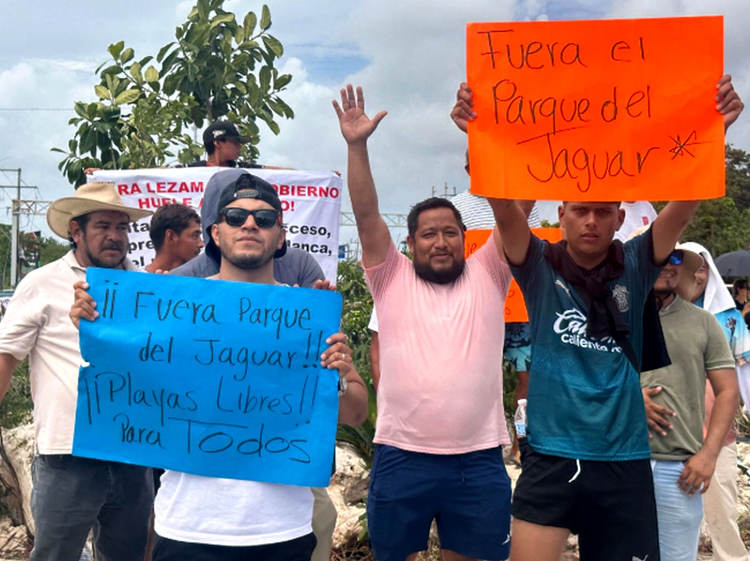
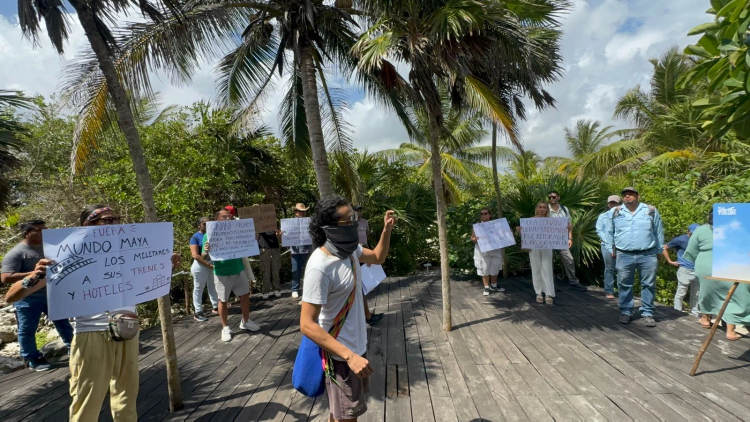
On May 3, 2026, more than 100 residents of Tulum blocked Federal Highway 307 at the entrance to the archaeological zone, demanding what the government had already promised them, in writing, four times over the previous six months: free, unrestricted access to the beaches inside Parque Nacional del Jaguar. The protest lasted most of the morning. No new agreements were announced.
The conflict is specific in geography and specific in cause. It concerns a defined stretch of Tulum's northern coastline, the beaches inside the 2,913-hectare Jaguar Park that runs along the cliffs where the Tulum ruins sit and extends deep into the jungle west of Highway 307. South of this zone, Tulum's hotel strip continues for several kilometers toward Boca Paila, with dozens of beach clubs and hotels offering varying degrees of public access. The beach dispute at the center of Tulum's worst tourism season in a decade is not about that southern stretch. It is about who controls the coast at the northern end of town, and why five consecutive official agreements have failed to resolve it.
Understanding the geography of the conflict
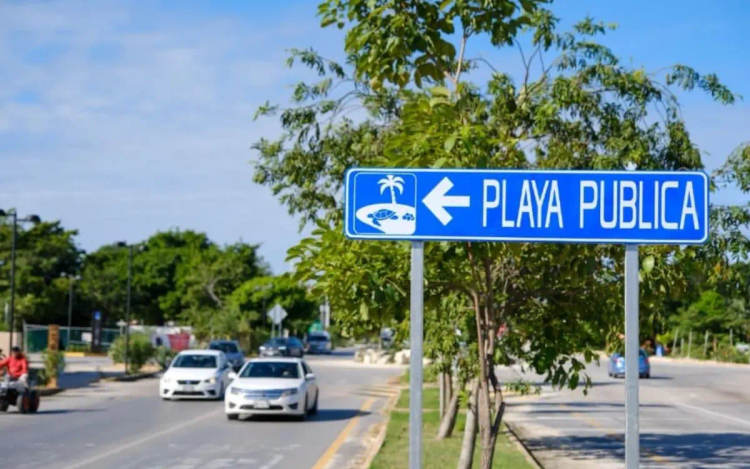
Tulum's coastal zone divides into two functionally distinct sections. To the south of Avenida Cobá, the hotel zone runs for roughly 10 kilometers toward the Sian Ka'an biosphere reserve. Along this stretch, free beach access has expanded significantly since 2025, with 15 hotels and beach clubs agreeing to allow passage through their properties without cover charges or minimum consumption requirements. Official public access points were established at Playa Conchitas, at kilometer 4.5, and Playa del Pueblo, at kilometer 5.5 of the coastal road. These openings drew national attention and were presented by municipal authorities as evidence that Tulum was reversing its reputation for privatized beaches.
The northern section is a different matter entirely. From the intersection with Avenida Cobá north to the Tulum ruins, the coastline falls inside the boundaries of Parque Nacional del Jaguar. This protected area covers 2,913 hectares spanning both sides of Highway 307 and encompasses the beaches of Playa Santa Fe, Playa Pescadores, Playa Maya, and Playa del Mangle, all of them below the cliffs that made Tulum famous. Access to this section of coast is controlled by a single entity: the Secretaría de la Defensa Nacional, through its parastatal company Grupo Aeroportuario Ferroviario y de Servicios Auxiliares y Conexos Olmeca Maya Mexica, known until May 2025 as Gafsacom and since rebranded as Grupo Mundo Maya.
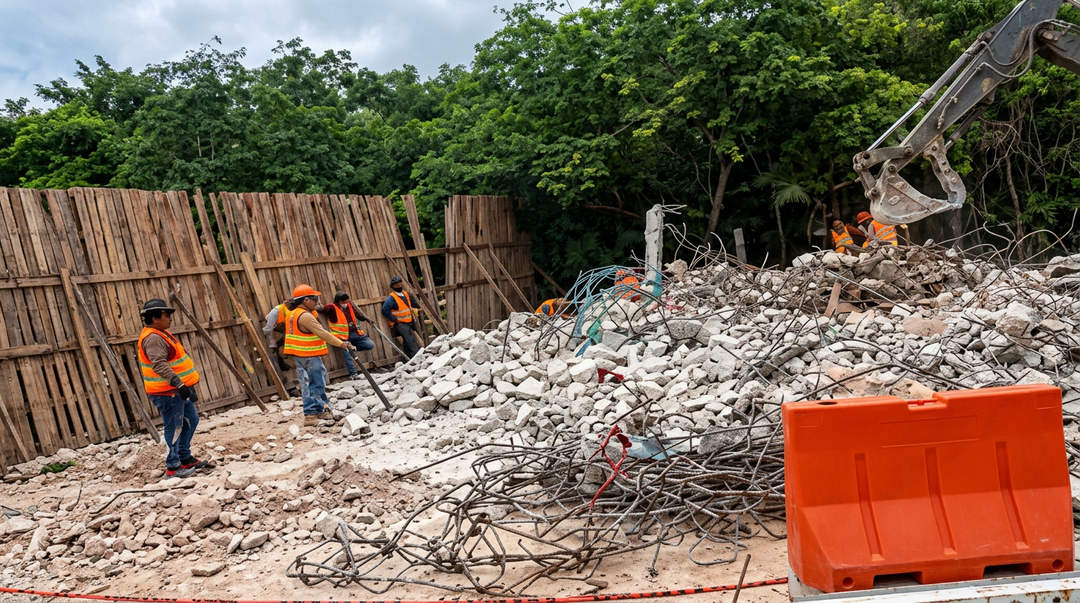
That distinction matters. The free-access agreements celebrated in late 2025 largely addressed the hotel zone to the south. The northern beaches, the ones historically associated with Tulum's ruined city by the sea, remain under military administration with conditions that residents and businesses say have never been consistently honored.
How the park was built and who was handed the keys
The Parque Nacional del Jaguar opened formally on September 28, 2024, following a federal investment of more than 2.7 billion pesos. The project integrated two previously separate protected areas: the Tulum National Park, home to the archaeological zone, and the Jaguar Flora and Fauna Protection Area. The combined reserve brought the ruins, the beaches below them, several kilometers of jungle trail, an observation tower 82 feet above the canopy, a museum of Maya cultural heritage, and a network of electric shuttle routes under a single administrative framework.
Gafsacom, formally established by presidential decree on April 13, 2022, under then-president Andrés Manuel López Obrador, was created to build and operate major federal infrastructure in the southeast, including the Maya Train, regional airports, and touristic sites. On December 5, 2024, without prior public notice, the Guardia Nacional closed the main entrance to the Tulum archaeological zone overnight and redirected all visitor flow through the new park infrastructure. From that date, Gafsacom held the gates.
On May 30, 2025, the company changed its name to Grupo Mundo Maya. According to its director, Adolfo Héctor Tonatiuh Velasco Bernal, the rebranding was intended to "connect and promote the natural, historical and cultural richness of southeastern Mexico." The new name did not alter the operational structure. Grupo Mundo Maya still controls the Jaguar Park, the Tulum International Airport, and a portfolio that now includes hotels in archaeological zones across the region and a chain of cultural museums. All of it answers to the Secretaría de la Defensa Nacional.

The fee structure that triggered the crisis
When Gafsacom took over operations in December 2024, it introduced a layered fee structure that caught residents and tourists unprepared. Visitors were required to pay three separate charges to enter the park and reach its beaches: 60.37 pesos to the Comisión Nacional de Áreas Naturales Protegidas (Conanp), 95 pesos to the Instituto Nacional de Antropología e Historia (INAH) for access to the archaeological zone, and a Gafsacom park entry fee of 195 pesos for Mexican nationals or 295 pesos for foreigners. Combined, an international visitor was effectively paying roughly 22 U.S. dollars just to reach sand that had been freely accessible for more than four decades.
Visitors who wanted only the beach, not the ruins, still faced the full Conanp and park fees. The access points operated on fixed hours, 8 a.m. to 7 p.m., ruling out sunrise visits. Staff checked bags to prohibit outside food and beverages. The Guardia Nacional was stationed at the entry points. From the central access, reaching the nearest beach required a walk of more than 1.5 kilometers through jungle paths that were, in several documented reports, poorly maintained and difficult for visitors with reduced mobility.
The Mexican Constitution defines beaches as national assets for common use. The Ley General de Bienes Nacionales guarantees free public access to all Mexican coastline. Neither legal instrument was visibly operative at the Jaguar Park entrance on any given morning in 2025.
The promises, in chronological order
The backlash was immediate. Within weeks of the December 2024 opening, local business owners, artisan vendors who had operated near the archaeological zone entrance for years, and residents organized protests at the park gates. What followed was a sequence of official interventions, each announced as a resolution, none of them durable.
August 2025. Mayor Diego Castañón Trejo announced that Tulum residents could enter Jaguar Park beaches at no cost by presenting their INE voter ID card. Within days, residents reported the arrangement was not being honored at the access points. Castañón himself acknowledged publicly that Gafsacom had not complied with the agreement. "We had many complaints from locals that they were not being let onto the beach because it is inside Jaguar Park. Gafsacom and we had made an agreement, and that agreement was that showing their credentials they could enter, but that agreement has not been respected," he said.
September 2025. Fifteen hotels and beach clubs in the hotel zone to the south agreed to open free passage through their properties. The arrangement provided an alternative for visitors staying in or near those properties. It offered nothing for residents seeking access to Playa Santa Fe or Playa Pescadores, the beaches directly below the ruins, reachable only through park infrastructure.
November 5, 2025. Federal Tourism Secretary Josefina Rodríguez Zamora announced that a federal working group involving 14 agencies had reached new agreements with Grupo Mundo Maya. Two public access points were opened inside Jaguar Park, the southern entrance on Avenida Cobá and the traditional central entrance. Rodríguez Zamora stated: "No visitor will be charged for beach access at any time of year." A unified pricing structure was introduced for visitors to both the park and the archaeological zone, in effect through December.
November 12, 2025. Governor Mara Lezama held a press event inside the park and declared that Playa Santa Fe, Playa Pescadores, Playa Maya, and Playa del Mangle were free to everyone, every day of the year. "Tulum is for everyone, without discrimination," she said. Police were stationed at access points.
November 2025. The federal government launched Tulum Renace, a 128-action strategy developed across 14 federal agencies. Free beach access was listed among the plan's foundational commitments.
April 23, 2026. On the 45th anniversary of the Tulum National Park, a new protest took place, again centered on beach access inside Jaguar Park.
May 3, 2026. More than 100 residents blocked Highway 307. Their signs read: "Claudia, the beaches belong to Tulum." "A presidential decree stole our beaches." "Grupo Mundo Maya and Conanp are profiting from our park." The group demanded the removal of both Gafsacom/Grupo Mundo Maya and Conanp from beach management, the reform of the park's management program to include citizen participation, and direct presidential intervention. No agreements were announced.
What the collapse cost Tulum in numbers
The fee dispute at Jaguar Park did not cause Tulum's tourism crisis alone, but it arrived at the worst possible moment and amplified every other problem the destination was already carrying. Hotel occupancy in the coastal zone dropped to roughly 30% during the summer of 2025, with town-center rates falling as low as 15%. In September 2025, occupancy stood at 49.2%, compared to 66.7% in September 2024, a decline of 17.5 percentage points recorded by the Quintana Roo Secretary of Tourism.
The archaeological zone told the starkest story. Tulum's ruins, once the third most visited archaeological site in Mexico, received approximately 75,000 visitors in September 2024. In September 2025, the figure was 18,000, a drop of more than 75%, according to Mexico's Tourism Secretariat. Average nightly hotel rates had reached $450 in 2025, a 25% increase from 2023, even as the rooms filling those hotels were emptying. Luxury properties cut rates by up to 35% to attract any occupancy at all.
Airlines drew their own conclusions from the demand data. United and JetBlue suspended or reduced service. Air Canada canceled its seasonal Tulum route entirely. In August 2025, Discover Airlines became the third carrier that year to announce withdrawal from the Felipe Carrillo Puerto International Airport, citing high on-site handling costs, inadequate ground transport, and weak demand. The airport, which processed 5,026 international operations in all of 2024, reported only 3,514 in the first seven months of 2025.
The role of sargassum, and its limits as an explanation
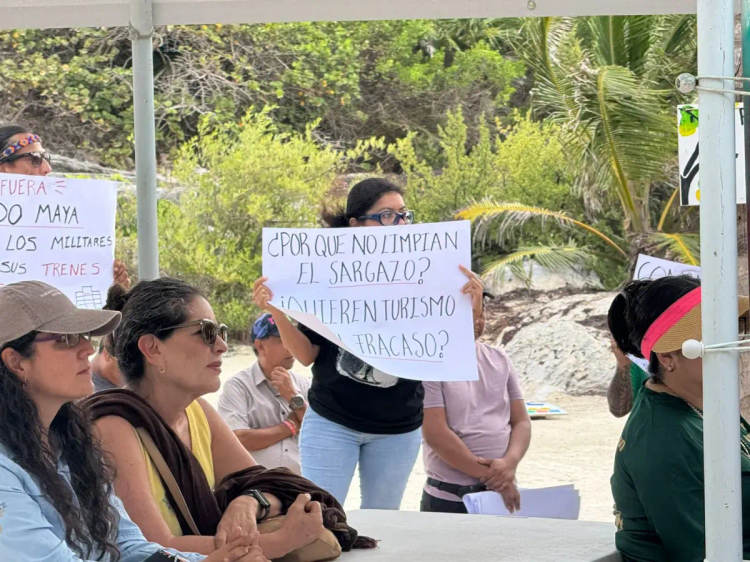
State and municipal officials pointed consistently to record sargassum arrivals as the primary driver of the decline. The 2025 bloom was genuinely severe. By April, massive mats had covered Tulum's beaches, turning turquoise water brown and generating the smell of decomposition that video after viral video documented for international audiences. But sargassum strikes the entire Caribbean. Playa del Carmen, Holbox, and Puerto Morelos navigated the same season without comparable occupancy collapse. What Tulum had that those destinations did not was a simultaneous policy decision to impose fees at the access points to the most iconic stretch of its coastline, at precisely the moment when the beach experience was at its least attractive.
José Enrique Vidal Dzul Tuyub, secretary general of the Sindicato Nacional de Trabajadores de la Secretaría de Cultura, said the damage was structural, not seasonal. "Before, Mexicans could enter for free on Sundays. Now they pay multiple fees. The route to the site is longer and more complicated. They destroyed the beach-culture combination that made Tulum one of the most attractive destinations in the Mexican Caribbean."
The institutional problem no agreement has solved
The core difficulty for residents and for any administration trying to honor the free-beach promises is structural. The entity controlling Jaguar Park's access points is not a private company that can be pressured through municipal ordinance or state decree. Grupo Mundo Maya is a parastatal company of the Secretaría de la Defensa Nacional. It holds its concession through a federal assignment. The organizations that set conditions within the protected area, Conanp and INAH, are also federal bodies. Municipal President Castañón and Governor Lezama have limited legal authority to compel compliance from federal military-administered infrastructure.
Protest documents submitted to the federal government on May 3 identified two specific individuals as central figures in the access dispute. Fernando Orozco Ojeda, the Conanp regional director, was cited for imposing arbitrary fees on tourism workers and artisans in the coastal zone. Those same documents noted that Orozco Ojeda had been removed from his position in 2020 following findings of corruption and abuse of authority against workers, and that his return to a supervisory role had never been publicly explained. The park's director, María del Carmen Morales Pérez, was cited for carrying out unjustified charges against tourism service workers. The Secretaría de la Defensa Nacional has not publicly responded to these allegations.
Residents also raised a concern about the INE-based access arrangement that extended to May 2026 in various forms. The measure excluded foreign residents of Tulum without a Mexican voter ID and applied only to those who could prove local residency, leaving domestic tourists from outside Quintana Roo and most international visitors in the same fee-paying category. One protest document described this as discriminatory, given that Tulum's community includes a substantial population of foreign nationals who contribute to the local economy year-round.
The sargassum of 2026 is already worse
Whatever partial recovery Tulum achieved in the winter of 2025 is now being tested by an environmental situation harder than the one that preceded it. Zofemat data shows the scale of the acceleration clearly. In January 2024, crews removed 36 tons of sargassum from Tulum's coast. In January 2025, that figure was 79.64 tons. In January 2026, it reached 235 tons. February followed the same pattern: 50 tons in 2024, 59 tons in 2025, 243 tons in 2026. By mid-May 2026, more than 1,700 tons had been removed since January, with the Mexican Navy deployed alongside Zofemat brigades working from 6 a.m. daily.
The municipality installed 10 large metal containers along the hotel zone for sargassum disposal, serving more than 25 beachfront hotels. Mayor Castañón described the effort as a "challenge we take on responsibly," while acknowledging it is a global phenomenon with no near-term solution. The peak sargassum months, typically May through August, have not yet arrived.
Recovery numbers, and what they do not resolve
By November 2025, hotel occupancy in Tulum had climbed back to approximately 73%, rising to an estimated 80% in December, with projections of 90 to 95% occupancy for the holiday period. The Tulum Renace strategy, backed by 14 federal agencies and announced at the Palacio Nacional, was presented as a structural reset rather than a seasonal adjustment. Tourism Secretary Rodríguez Zamora reported that 1.3 million tourists had visited Tulum between January and October 2025, and that the airport had seen a 9.4% increase in passengers in that period.
The winter rebound offered real relief to hotels and some service providers who had absorbed months of losses. It did not end the disputes inside Jaguar Park. No airline that had withdrawn from the Tulum airport announced a return. Matteo Luthi, COO of Journey Mexico and one of the region's most closely followed tourism analysts, summarized what Tulum had lost in terms that went beyond seasonal fluctuation: "People loved it because you'd arrive, kick off your shoes, forget your watch and relax. That magic started to erode as success gave way to overconfidence. Travelers who gave up on Tulum weren't leaving Mexico. They were going to Holbox. To Bacalar. To Puerto Morelos."
Those are destinations that have not yet priced out their own appeal, and that do not yet have a military-administered park controlling access to their most iconic stretch of coast.
The question Tulum enters its 2026 high season carrying is whether the structural contradiction at the center of its access dispute, beaches that are public by law, administered by an arm of the federal military under a concession that no municipal or state authority can unilaterally revoke, can be resolved by the same chain of government that has issued five consecutive promises without producing a durable outcome. On May 3, residents blocking the highway were not asking a rhetorical question. They were pointing to an answer that has not changed since December 2024.
Do you believe Tulum's Jaguar Park beaches can be genuinely returned to free public access while Grupo Mundo Maya holds the federal concession? Join the conversation and share your perspective with us on Instagram and Facebook at @thetulumtimes.

The Tulum Times · Newsletter
The story continues in your inbox.
Essential Tulum news and local insight, a few times a week. Free.
No spam. Unsubscribe anytime.
Beach Access, Public Shoreline, and Coastal Rules in Tulum
Coverage of public beach access, coastal restrictions, closures, and the balance between tourism and public space.

“The best journalists reporting from paradise, highlighting the heroes that keep Tulum the most beautiful place in the world! THANK YOU!”


