


President Claudia Sheinbaum arrives in Tulum on Thursday afternoon and will spend four days in Quintana Roo, where a 415 peso beach fee, a sargassum surge, and the cargo Maya Train are waiting for her.
She announced the trip at the top of Thursday's Mañanera del Pueblo in Mexico City, with a line that needed no elaboration. "We are going to Tulum today," she said, before setting out three priorities for a tour that keeps her in the state until Sunday, July 19. All quotes here are translated from Spanish.
Cabinet secretaries have been working this file for close to a year. Alicia Bárcena at Environment, Josefina Rodríguez at Tourism, the National Commission of Natural Protected Areas, and Mundo Maya, the military-run company that operates the park, have each had a turn at it. On Thursday, the president conceded that the problem has outlived all of them. "There are still some problems, so we are going to go resolve them," she said. Friday's national press conference will be broadcast from Tulum itself, which means whatever answer she gives arrives with a national audience attached.
Sheinbaum starts in Tulum with a walk through the Jaguar Park
The first stop is the archaeological zone and the park built around it. Sheinbaum said she will meet there with federal institutions, hotel owners, and local merchants.
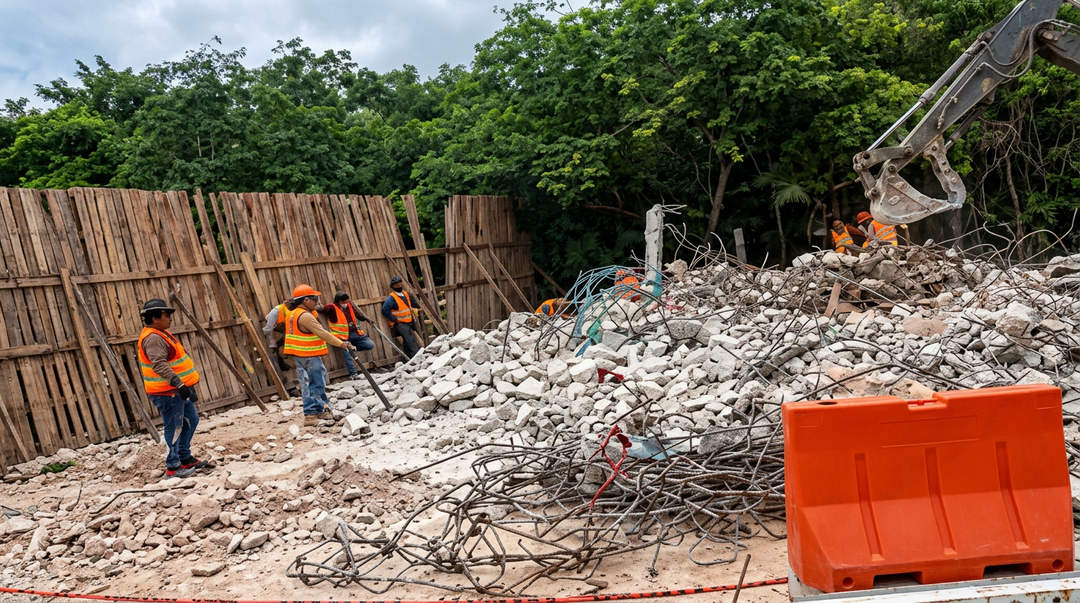
"Discontent persists among those who arrive in Tulum, so we are going to see exactly what is happening," she said. "There, with all the institutions, we are going to resolve it, talk with the hoteliers, with the merchants of the area, to see exactly what is happening and how we resolve it."
Local reporting by Grupo Cantón, published a day before the announcement, said the agenda includes private meetings with tourism sector representatives and a tour of the park. Unnamed federal government sources told regional outlets the four days will also take in Playa del Carmen, Puerto Morelos, and Benito Juárez. The Presidency has not published a full itinerary.
How a 2022 park project became a 415 peso argument
The Jaguar Park was created in July 2022 under Andrés Manuel López Obrador and inaugurated in September 2024 through the urban improvement program of the Agrarian, Territorial and Urban Development Secretariat. It merged Tulum National Park, which contains the ruins, with the Jaguar Flora and Fauna Protection Area. Operation then passed to the Army through GAFSACOMM, the airport, rail, and auxiliary services company that trades as Mundo Maya and also runs airports, hotels, and the Maya Train.
Beaches that had been open for decades acquired a price. According to the petition now circulating, foreign visitors pay roughly 415 pesos, Mexican nationals 255 pesos, and Quintana Roo residents 105 pesos, with a mandatory golf cart transfer from the main entrances folded into the ticket. A legislative initiative filed last year named Santa Fe, Pescadores, and Paraíso among the beaches affected.

The friction has not stayed rhetorical. On August 31, 2025, more than 500 people blocked the Riviera Maya corridor for over six hours, stranding some 600 motorists and leaving tourists to walk roughly three kilometers with their luggage toward Playa del Carmen and Cancún. Days earlier, Tulum mayor Diego Castañón Trejo, of Morena, had publicly accused the company of failing to honor agreements guaranteeing free access for residents. Mundo Maya rejected that, saying an agreement allowing free entry to citizens and documented foreign residents remained in force, and pointing to free Sundays and to alternate access points that carry no charge.
The visitor numbers behind the complaints
The economic claim has figures behind it, though the causes are contested. Data from INAH and the Tourism Secretariat, cited by Noticaribe, put attendance at the Tulum archaeological zone at 628,000 in the first half of 2025, about 137,000 fewer than the same period of 2023, before the fees took effect and before the temporary closures for Maya Train and Jaguar Park construction. In October 2025, Grupo Animal reported hotel occupancy in Tulum running 17 percent below the previous year.
Assigning blame is where it gets difficult. Tulum's slump has been attributed to the park fees, to prices across the destination, to insecurity, to sargassum, and to a market correcting after years of fast expansion. The petition assigns it to the park. Launched on May 26, 2026, by Valeria del Carmen López Blanco under the title "Tulum is not for sale and will not be fenced in," it demands the separation of the Jaguar Park from the archaeological zone and had passed 3,300 signatures by late June.
A law against beach charges already passed the Chamber of Deputies
What makes Friday's press conference genuinely awkward is that Congress has already ruled on the principle. On October 1, 2025, the Chamber of Deputies approved, 465 votes to zero, a reform to the General Law of National Assets and the General Law of Ecological Balance establishing that access to maritime beaches and the adjacent federal zone must be open, free of charge, and permanent for all people regardless of origin, nationality, or social condition. The text prohibits the imposition of charges, fees, or restrictive conditions, with exceptions only for environmental protection, public security, or national interest. It came from Ricardo Monreal and Enrique Vázquez Navarro, the Morena deputy for Quintana Roo. The Senate confirmed receiving the bill days later.
One clause complicates the picture. For protected natural areas, the reform requires the Environment Secretariat to guarantee free access at least one day a week, which is close to what the Jaguar Park already offers on Sundays. The park sits inside both a national park and a protected area. Which rule governs which stretch of sand is exactly the sort of question a president standing in Tulum can be asked.
Sargassum, and a solution the president says already exists
The second priority is visible from every beach on the coast. Sargassum increased this year "because of the characteristics of increased ocean temperature," Sheinbaum said, and the federal government has met on it several times.
Her stated approach is to harvest the seaweed at sea and recycle what is collected, rather than fight it once it rots on the sand. A first diagnosis exists. The weekend adds direct observation of where the accumulation is heaviest.
"We already have a solution, but we are going to go observe the problem," she said. Moments later she softened it, saying the trip would serve "to resolve it, or at least to lay out the strategy." The two statements sit uneasily beside each other, and Sunday is when they get reconciled in public.
Cargo locomotives, and Sunday in Puerto Morelos
The third item is the freight version of the Maya Train. The first locomotives have arrived, Sheinbaum said, and she will inspect them and receive a progress report on the works. She gave no new dates for service.
The rest of the schedule is fixed. Friday, July 17, the daily press conference from Tulum, where the government will explain how it intends to address the municipality's problems. Saturday and Sunday, sargassum and other matters. Sunday, July 19, a second press conference to present the general strategy. She named Cancún first and then corrected herself to Puerto Morelos, where Infobae reported the event is scheduled for around midday.
Tulum has had a petition since May, a highway blockade since last August, and a reform text since October that says in plain language that beaches cannot be charged for. What it has not had is the president in the room. On Friday morning she will be, with a national broadcast behind her and hoteliers, merchants, and the Army's tourism company in front of her. The number to watch afterward is not the signature count. It is 415.
If Congress voted to make beach access free, should the Jaguar Park still be charging 415 pesos to reach the sand? Join the conversation and share your perspective with us on Instagram and Facebook at @thetulumtimes.
This image was generated or enhanced using artificial intelligence to improve its quality.

The Tulum Times · Newsletter
The story continues in your inbox.
Essential Tulum news and local insight, a few times a week. Free.
No spam. Unsubscribe anytime.
Transportation in Tulum: Taxi, Bus, Transfers, and Mobility
Taxi fares, buses, transfers, road changes, mobility updates, and practical transport guidance for Tulum.

“The best journalists reporting from paradise, highlighting the heroes that keep Tulum the most beautiful place in the world! THANK YOU!”


