


The National Institute of Anthropology and History (INAH) has transferred 10,000-year-old human fossils from Tulum’s Sac Actun cave system to Mexico City for expert bioarchaeological study and analysis.
This strategic transfer marks a significant milestone in the study of the region’s first inhabitants. The remains, which were initially reported in 2022 and recovered in late 2025, were delivered to the Bioarchaeology Section of the Directorate of Archaeological Salvage. Packed in airtight, climate-controlled containers, the fossils were received by physical anthropologist Arturo Talavera González, who will lead a team of specialists in decoding the biological history written in these ancient bones.
For those living in or visiting Tulum today, the discovery serves as a profound reminder that the ground beneath their feet is a geological and historical archive unlike any other on the planet. These findings do not just represent old bones; they are the keys to understanding how the first humans navigated a world that prehistoric Tulum would have barely recognized.
The Face of Ancient Tulum
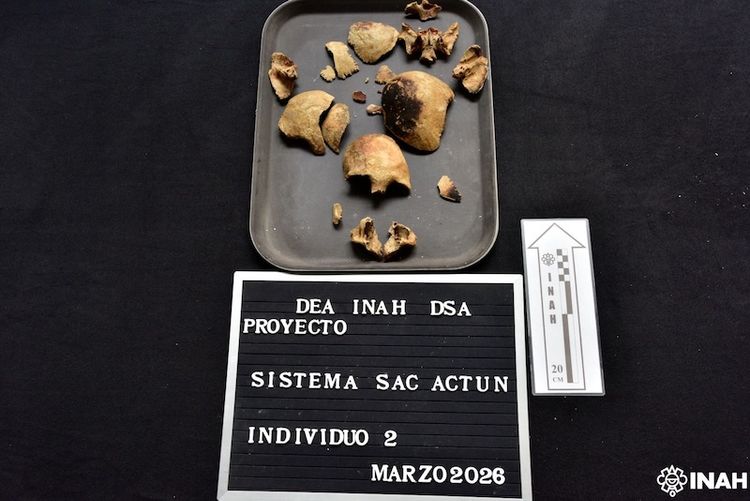
Initial observations by Talavera González have already begun to flesh out the identities of these ancestors. The most complete find is the skeleton of a young man, estimated to be between 20 and 25 years old at the time of his death. Despite the thousands of years spent submerged in the mineral-rich waters of the cenote system, approximately 40 percent of his skeleton has been recovered. This includes vital diagnostic parts of the skull, ribs, vertebrae, clavicles, and the right scapula, as well as fragments of the hip and long bones from both upper and lower limbs.
Standing at a modest height of approximately 1.45 to 1.50 meters, this individual was of slim build, a physical trait likely adapted to the challenging terrain of the era. Because of the delicate state of preservation, the remains have immediately entered a consolidation process. This necessary step will stabilize the bone material before it can be handled for the more detailed osteometric and chemical studies planned for the coming months.
The discovery is not limited to a single individual. During the same exploration of the Sac Actun system, researchers also recovered a female skull belonging to a woman estimated to be between 35 and 45 years old. Unlike the younger male, her remains tell a story of physical hardship. Preliminary analysis indicates she suffered from prolonged periods of malnutrition and significant dental loss, providing a stark look at the survival challenges faced by early populations in the peninsula.
A Natural Burial Crypt
The archaeological context of these finds, explained by project advisor and academic guarantor Luis Alberto Martos López, is as fascinating as the remains themselves. The male skeleton was located at the bottom of a cenote, approximately 200 meters from a natural entrance and at a depth of eight meters underwater. However, to understand the true significance of this location, one must look back nearly ten millennia.
According to Martos López, the presence of a significant amount of charcoal at the site indicates that 8,000 to 10,000 years ago, this area was a dry cavern. During that period, the sea level was between 20 and 30 meters lower than it is today. What is now a subterranean river system was once a shelter and, as the evidence suggests, a site for funerary rites.
"There were hearths, which indicates that the cave was active and that, probably, when this person died, they used the chamber as a natural burial crypt," Martos López noted. This find speaks volumes about the spiritual lives and belief systems of these early peoples, suggesting that even in the harshest conditions, they honored their dead with specific rites and protected locations.
The Lost Landscape of the Yucatán
To envision the world these individuals inhabited requires a radical shift in perspective. During the late Pleistocene and early Holocene, the Yucatán Peninsula was not the dense tropical jungle we see today. Instead, it was a vast grassland punctuated by shrubs and hardy grasses, with far fewer trees and an abundance of megafauna that has since gone extinct.
In this open, arid landscape, the caves served as more than just temporary shelters; they were life-sustaining hubs with access to freshwater and protection from the elements. The transition from a dry prairie to the water-filled cave systems occurred as global temperatures rose and sea levels climbed, eventually flooding the chambers and sealing the remains in an aquatic vault for thousands of years.
The scientific significance of these Tulum human fossils is immense. "The transfer and study of these remains represent an important advance for the investigation into the first inhabitants of what is now Mexico," said federal Secretary of Culture Claudia Curiel de Icaza. The research team plans to use state-of-the-art technology to determine the exact age, diet, and possible causes of death for these individuals, alongside DNA analysis that could clarify their ethnic affiliations.
Investigating Ancient Ancestry
One of the more intriguing hypotheses currently under investigation concerns the female skull. While its physical characteristics are still being studied, researchers are considering the possibility of a different ethnic affiliation, with some hypotheses pointing toward potential lineage variations that could reshape the migration map of the early Americas.
Archaeologists at the INAH Quintana Roo Center emphasize that these recovery efforts are strictly governed by protocols for the protection of underwater cultural heritage. The delicate rescue operation was necessary to prevent the loss of information due to the changing humidity levels and the general environmental sensitivity of the Sac Actun system.
As the study progresses in Mexico City, the data recovered will be shared with the broader scientific community, potentially revealing new details about the genetic diversity of the first Americans. For the people of Tulum, these discoveries underscore the importance of conservation, reminding the local community that every cenote is not just a natural wonder, but a sacred historical museum.
*AI-generated cover image.
What do the ancient rituals of the Yucatán’s first inhabitants reveal about our shared history? Join the conversation and share your perspective with us on Instagram and Facebook at @TulumTimes.