

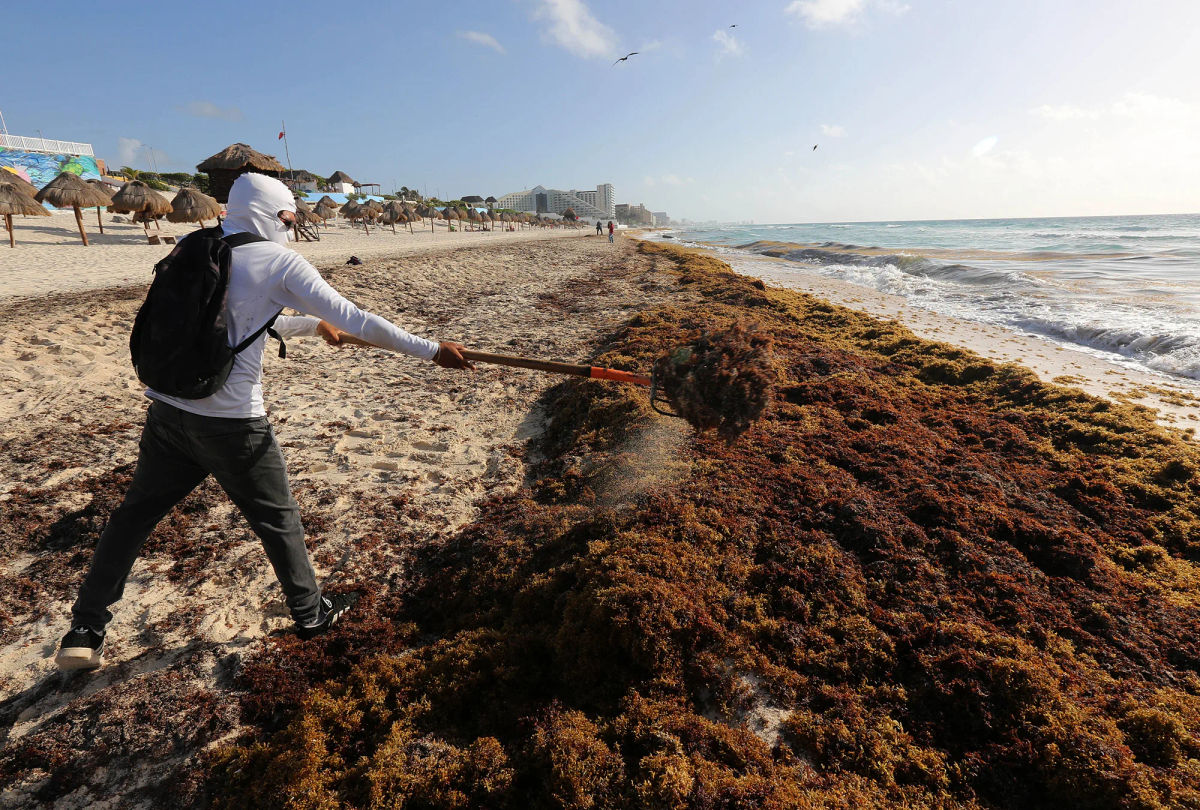
The Secretary of the Navy reported that Quintana Roo has successfully collected 16,797 tons of sargassum to protect regional health and tourism interests during the critical Semana Santa holiday season. While the immediate focus remains on maintaining the pristine appearance of Mexico's Caribbean coastline, a broader federal shift is currently underway.
This seasonal effort is not merely a matter of beach maintenance. It represents the first phase of a sophisticated logistical operation that now integrates advanced scientific research. For the first time, the massive arrival of sargassum is being viewed as a permanent resource rather than a temporary emergency.
The Frontline of Containment
The Strategy for Sargassum Attention (Estrategia de Atención al Sargazo) operates through a strict coordination between the federal government, state authorities, the Federal Maritime Terrestrial Zone (Zofemat), and the private hotel sector. This multi-layered approach ensures that resources are deployed where they are needed most.
The scale of the operation is significant. Currently, 185 elements of the Fifth Naval Region are deployed across the state's most critical entry points. These specialized teams are not just laboring on the sand; they are operating a high-tech fleet designed specifically for maritime interception.
The naval deployment includes:
- Four specialized monitoring drones for early detection.
- Eleven coastal sargassum vessels.
- Four amphibious sargassas units for shallow water work.
- One oceanic sargassum vessel for deep-water collection.
- Eighteen support boats.
- 7,050 meters of containment barriers strategically placed in the water.
This hardware is active in the region's main tourism hubs, including Isla Mujeres, Benito Juárez (Cancun), Puerto Morelos, Playa del Carmen, Tulum, and Othón P. Blanco (including Mahahual and Xcalak). By intercepting the algae before it reaches the shore, the Navy reduces the environmental impact on the delicate coastal ecosystem and prevents the decomposition that affects human health.
Beyond the Beach: The Industrial Transition
While the Navy handles the physical collection, the Secretariat of Science, Humanities, Technology, and Innovation (Secihti) is leading the intellectual and industrial response. The federal government has confirmed the development of a biorefinery designed to transform this organic material into high-value industrial products. This move represents a fundamental pivot in the "Estrategia de Atención al Sargazo," shifting from a logic of disposal to one of utilization.
This shift marks a departure from previous years where sargassum was often discarded in improvised inland landfills, creating secondary environmental risks such as groundwater contamination and the leaching of heavy metals into the cenote systems. The new pilot biorefinery is a direct result of the "Red Ecos de Sargazo," an unprecedented collaborative network involving 155 researchers from 25 higher education institutions across 12 Mexican states. This brain trust has spent the last 24 months analyzing the biochemical composition of the algae to ensure that the resulting products are both safe and economically viable.
The primary objective of Red Ecos is to implement standardized processes for the collection and processing of sargassum. This scientific approach aims to mitigate the environmental risks of massive arrivals, which are technically known as "arribazones." These accumulations are caused by specific meteorological phenomena, including changes in wind patterns and the warming of the Atlantic "Sargassum Belt." Left untreated on the shoreline, these arribazones can alter the PH of the water, deplete oxygen levels, and devastate local seagrasses and coral reefs.
Technical Performance and Circular Economy
The technical specifications of the new biorefinery suggest a viable industrial future for sargassum management. The facility is designed to be self-sustaining in terms of both energy and water consumption, addressing two of the most common criticisms of large-scale industrial operations in the Quintana Roo region. By utilizing the biogases produced during the fermentation of the algae, the plant can power its own machinery, creating an almost closed-loop system.
Key performance indicators of the facility include:
- Processing Capacity: Minimum of 20 tons of wet sargassum per day, which is the equivalent of clearing several city blocks of shoreline daily.
- Energy Efficiency: The plant generates its own operation energy through the methane capture stage, reducing the carbon footprint of the cleanup effort itself.
- Output Diversity: Capable of producing biogas for local energy grids, biochar for soil restoration, bioethanol for industrial use, and highly refined biofertilizers.
- Bioplastics Development: Perhaps the most promising output is the extraction of alginates and cellulose for bioplastics, housewares, and packaging materials.
This versatility is crucial for the Riviera Maya's long-term sustainability. By producing biofertilizers locally, the region can reduce its reliance on imported petroleum-based chemicals for agriculture and the extensive landscaping required by the resort industry. Similarly, the production of bioplastics offers a direct alternative to the single-use plastics that currently plague marine environments and threaten the very wildlife that tourists come to see.
Implications for Tourism and Health
The immediate imperative for this management strategy is public health and the preservation of the tourism economy, which accounts for over 80% of Quintana Roo's GDP. When sargassum decomposes on the beach, it releases hydrogen sulfide and ammonia, gases that are not only notoriously pungent but can cause significant respiratory irritation and skin rashes in high concentrations.
By maintaining 16,797 tons of material away from the shore, the Navy and Zofemat are directly protecting the health of thousands of visitors. This is particularly vital during the Easter period, when Quintana Roo experiences its highest visitor numbers of the year. The ongoing labors of the Emergency Beach Collection Group ensure that even in zones of high influx, the impact of sargassum remains controlled. This group functions as a rapid-response unit, moving barriers and personnel within hours of a major arribazón alert.
However, the Secihti's involvement suggests that the government is no longer satisfied with simple containment. The goal is to build an industry that can survive when tourism fluctuates. By creating a value chain through the biorefinery, Quintana Roo is positioning itself as a leader in marine biotechnology. This economic diversification is essential for a region that has historically been over-dependent on international travel trends and seasonal weather patterns.
The Path Forward: A National Model
The 2026 season serves as a proving ground for this integrated approach. The combination of naval precision and scientific industrialization suggests that Mexico is finally moving past the "emergency" phase of the sargassum crisis. The presence of the oceanic sargassas vessel, a massive ship capable of harvesting tons of algae per hour, indicates that the strategy is scaling up.
The success of the 16,000-ton collection effort provides the raw material necessary to validate the biorefinery project. If the pilot facility can consistently process 20 tons daily, the next step would be the deployment of larger, regional hubs that could turn the entire Mexican Caribbean into a center for sustainable bio-production. This would move the sargassum problem from the "liability" column to the "asset" column on the national balance sheet.
For now, the work continues. Containment barriers remain in place from Tulum to Cancun, and naval personnel continue to monitor the early-warning drones. The immediate victory is a clean beach for Easter travelers, but the long-term victory will be the transformation of an environmental threat into an economic engine that benefits both the people and the planet.
Will the transition from beach cleanup to industrial processing solve the sargassum crisis for good? Join the conversation and share your perspective with us on Instagram and Facebook at @TulumTimes.
Support The Tulum Times
Independent journalism takes time and resources. If you found this article valuable, consider supporting our work!
Buy us a taco 🌮“The best journalists reporting from paradise, highlighting the heroes that keep Tulum the most beautiful place in the world! THANK YOU!”