
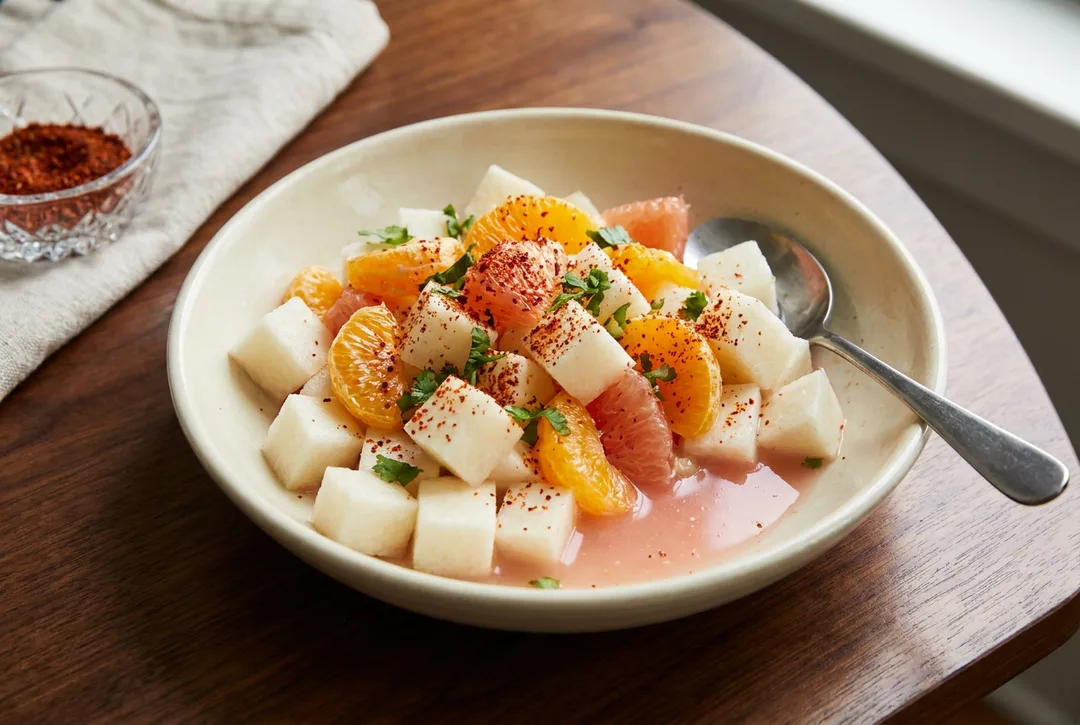
Xec, sometimes written xe'ek', takes its name from the Yucatec Maya word for a mixture, a jumble of things put together. That is more or less an instruction. Jicama, oranges, mandarins, whatever citrus the season has given, cut up and thrown in one bowl with salt, ground chilli and cilantro. There is no cooking, no dressing to emulsify, nothing to go wrong except bad fruit.
Around here it belongs to Hanal Pixán, the Yucatec observance of the days when the dead come back to eat. It goes on the altar in a bowl alongside the atole, the pib, the candied squash and the cigarettes, and it sits there while the families eat their own portions in the kitchen. The timing is practical as much as ritual: late October and early November is when the mandarins and the first decent oranges arrive, and jicama is cheap and heavy in the markets at Tulum and Chemuyil. Outside that season nobody is stopped from making it, and it turns up at fairs and outside churches year round, but the first week of November is when every household has a bowl of it.
The taste is blunt in a good way. Jicama is watery and sweet with a snap closer to a water chestnut than an apple. The citrus juice soaks into it, the salt pulls more juice out of both, and the ground chilli sits on top of all that heat and sourness without any sugar to soften it. By the time it has been cold for half an hour the bottom of the bowl holds a pink, cloudy liquid that people drink straight from the bowl when the solids are gone.
Two things get it wrong. The first is sugar. Xec is not a fruit cup, and syrup or honey turns it into something else entirely. The sweetness has to come from the fruit, which means buying fruit worth eating on its own. The second is dressing it too early. Salt on jicama draws water fast, and a bowl mixed in the morning for an evening meal will be limp and swimming. Thirty minutes to an hour of cold rest is the window. The chilli also matters more than people expect: ground dried chilli, piquín or a plain chile seco, has a clean burn, where a commercial chilli and lime seasoning brings its own salt, sugar and acid and flattens everything.
Ingredients
8 items · for 6Salad
- 1 large jicama, about 800 g, peeled
- 4 sweet oranges
- 3 mandarins
- 1 pink grapefruit (optional)
- 1 small bunch cilantro, about 20 g
- Juice of 2 sour oranges, or of 3 limes
To season
- 2 tsp ground dried chilli, piquín or another plain chile seco
- 1.5 tsp fine salt, plus more to taste
Step by step
8 stepsPeel the jicama
Cut a slice off the top and bottom of the jicama so it sits flat, then take the skin off with a knife rather than a peeler. There is a fibrous layer under the brown skin that a peeler leaves behind and that stays stringy in the bowl. Keep cutting until the surface is wet, white and clean all over.
Cut it to size
Slice the jicama into slabs about 1 cm thick, then into batons, then into cubes of roughly 1 cm. Some households cut thin half moons instead. Either works, but keep the pieces even so they salt at the same rate. Do not grate it: grated jicama collapses into pulp within minutes.
Segment the citrus
Cut the top and bottom off each orange, mandarin and the grapefruit, stand them on the board and cut the peel and white pith away in strips following the curve. Then cut the segments free from the membranes, working over a bowl so nothing is lost. Pick out the seeds as you go.
Save every drop of juice
Squeeze the leftover membranes and peel hard over the bowl. That juice is most of the dressing. Add the sour orange or lime juice to it. There should be enough liquid to pool around a handful of fruit, roughly 150 ml.
Chop the cilantro
Chop the cilantro including the tender upper stems, not just the leaves. It should be fine but not minced to paste. Set it aside separately rather than adding it now.
Mix and season
Put the jicama and citrus segments in a wide bowl, pour over the collected juice and add the salt. Turn it gently with your hands or a large spoon so the segments stay whole. Taste: it should be sour first, then sweet, with the salt obvious. Add more salt before you add more juice.
Rest it cold
Cover and refrigerate for 30 to 60 minutes. The jicama will give up water and the liquid at the bottom will turn cloudy and pink if there is grapefruit in it. This is the point at which the dish comes together, so do not skip it, and do not leave it much longer than an hour.
Finish and serve
Just before it goes to the table, scatter the cilantro and the ground chilli over the top and turn it once, lightly, so the chilli streaks through rather than dissolving. Serve cold in a bowl with a spoon, and put the extra chilli on the table for people who want more. The juice at the bottom gets drunk.
Notes from the kitchen
- Jicama outside Mexico is sold in Asian and Latin grocers, sometimes as yam bean or sa got. If there is none, a firm nashi pear or peeled kohlrabi gives a similar snap, though both are sweeter and need a little more lime.
- Sour orange is hard to find abroad. Use two parts lime juice to one part sweet orange juice as a substitute.
- Piquín is the usual chilli here. Any plain ground dried chilli works. A chilli and lime seasoning blend will do at a push, but drop the added salt and the extra citrus if you use it.
- Cut jicama and segmented citrus keep separately in the fridge for a day. Once salted and mixed the salad is best within two hours and watery by the next morning.
This is the standard household version made across the peninsula at the start of November, with the fruit list adjusted to whatever the Tulum market has that week.
This photograph was generated with artificial intelligence and may differ from the finished dish.