
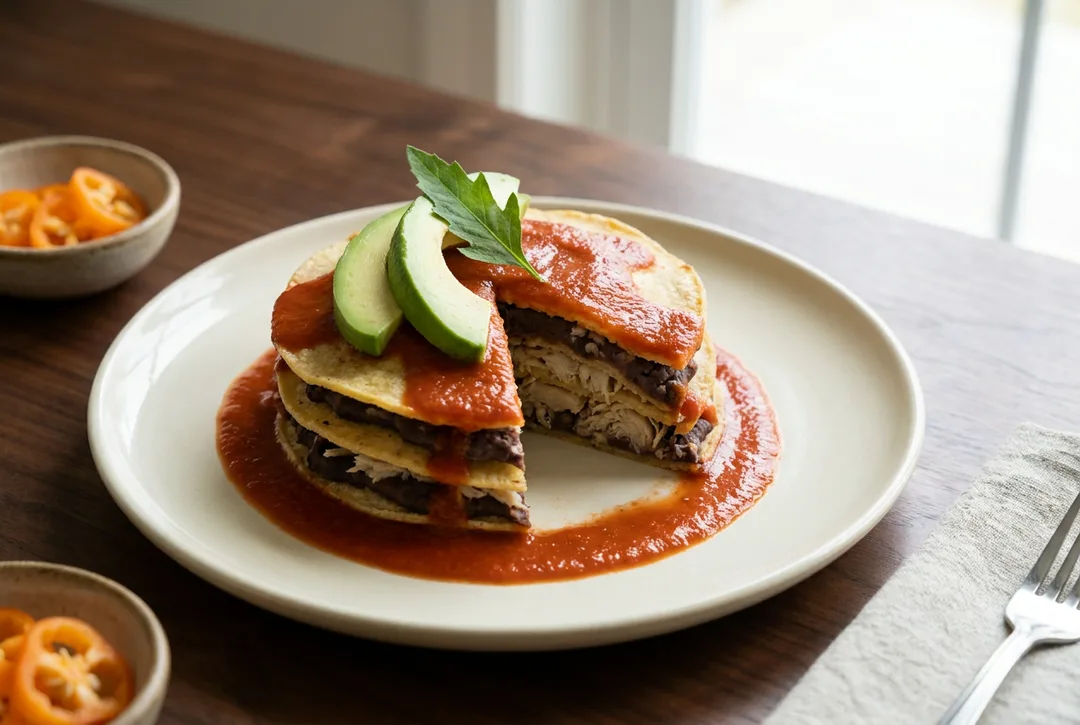
Pan de cazón contains no bread. The name throws people, and it keeps throwing them, because the word pan sits there promising something that never arrives. What arrives instead is a short stack: corn tortillas layered alternately with refried black beans and shredded cazón, the whole thing covered in a thin tomato sauce and eaten with a knife and fork. It belongs to Campeche, and it is the dish that city is known for outside its own state.
Cazón is small shark, the dogfish and smooth-hound sold whole or in thick steaks at fish counters around the peninsula. It is firm, mild and faintly sweet, and when cooked it pulls apart into threads rather than breaking into flakes the way snapper does. That texture is the point. Shredded and fried with onion, it holds its own between two soft layers of bean without turning to paste. The same cooked cazón goes into empanadas and tacos all along this coast, but the layered plate is where it is treated with the most care.
It is lunch food. In Campeche it is on the menu at fondas from one o'clock and sold out by three. Here in Tulum the fishmongers carry cazón irregularly, so it tends to be a dish you cook when you see it rather than one you plan a week ahead. Ask for it at the counter by name; if what you are shown smells sharply of ammonia, walk away, because fresh cazón does not.
On the plate it is quieter than it looks. The beans are earthy and loose, the fish is seasoned with little more than onion, garlic and epazote, and the tomato sauce is barely spiced, thin enough to run across the plate rather than sit on the stack. A whole habanero is steeped in that sauce and lifted out before serving, which perfumes it without making it hot. Heat is added at the table by whoever wants it, from a dish of sliced chilli.
Two things go wrong. The first is building it too far in advance, which turns the tortillas to mush; the components are all made ahead, but the stack is assembled and sauced at the last minute. The second is treating it as a baked casserole, layered in a dish and sent to the oven. It is not that. It is built plate by plate, three tortillas high, and served immediately while the sauce is still hot enough to steam.
Ingredients
25 items · for 6For the cazón
- 900 g cazón (dogfish or smooth-hound shark), in thick steaks or fillet
- 1 white onion, half left whole, half finely chopped
- 3 garlic cloves, peeled
- 2 sprigs fresh epazote
- 2 bay leaves
- 1 tbsp fine salt, for the poaching water
- 3 tbsp lard or neutral oil
- 2 medium tomatoes, finely chopped
- Salt, to taste
For the refried black beans
- 600 g cooked black beans (about 3 cups), plus 250 ml (1 cup) of their cooking liquid
- 3 tbsp lard or neutral oil
- 1/4 white onion, finely chopped
- 1 sprig fresh epazote
- Salt, to taste
For the tomato sauce
- 1 kg ripe red tomatoes
- 1/4 white onion, roughly chopped
- 1 garlic clove
- 2 tbsp lard or neutral oil
- 1 whole habanero, left uncut, stem on
- 1 sprig fresh epazote
- Salt, to taste
To assemble and serve
- 18 corn tortillas, 12 to 14 cm across, fresh and soft
- 2 avocados, sliced
- 1 habanero, thinly sliced, for the table
- 1 lime, cut into wedges
Step by step
8 stepsPoach the cazón
Bring 2 litres of water to a boil with the half onion, garlic cloves, bay leaves, one sprig of epazote and the tablespoon of salt. Lower to a steady simmer, add the cazón and cook for 12 to 15 minutes depending on the thickness of the pieces. It is done when the flesh has turned opaque white all the way through and gives easily when pressed. Lift it out with a slotted spoon and let it cool on a plate until you can handle it. Keep a cup of the poaching liquid.
Shred and clean the fish
Pull off and discard the skin. Shark has cartilage rather than bone, so look for the firm translucent central spine and any surrounding gristle and remove all of it. Pull the flesh apart with your fingers into fine threads. Go through the pile twice. A single piece of cartilage in a mouthful is the thing people remember about a badly made plate. You should have around 500 g of shredded fish.
Fry the fish
Heat the lard in a wide pan over medium heat and cook the chopped onion until soft and translucent, about 5 minutes. Add the chopped tomato and cook until it collapses and the pan looks dry at the edges, another 5 minutes. Add the shredded cazón and the remaining epazote sprig, season with salt, and stir for 4 or 5 minutes until everything is coated and hot. If it looks dry, add a splash of the poaching liquid. The mixture should be moist but not wet, with no liquid pooling in the pan.
Refry the beans
Heat the lard in a saucepan, soften the onion, then add the beans with their liquid and the epazote. Mash with a bean masher or the back of a spoon, or blend to a purée if you prefer it smooth, and cook over medium heat for 8 to 10 minutes, stirring. You want a thick spreadable paste that holds a line when you drag a spoon through it but still slumps slowly. Season with salt. If it tightens too much, loosen with hot water.
Make the tomato sauce
Simmer the whole tomatoes in water for 8 minutes until the skins split, then drain and blend with the onion and garlic until smooth. Heat the lard in a saucepan, pour in the blended tomato all at once, and cook for 12 to 15 minutes over medium heat, stirring now and then, until the raw smell has gone and the colour has deepened. Drop in the whole habanero and the epazote sprig, season with salt, and simmer 5 minutes more. The sauce should be thin enough to pour, roughly the body of single cream. Lift out the habanero and epazote before serving.
Warm the tortillas
Heat a dry comal or heavy pan over medium-high heat and warm the tortillas a few at a time, 20 to 30 seconds a side, until soft and pliable with a few pale blisters. Stack them in a cloth as you go. They must be soft enough to fold without cracking. Do this last, immediately before building, and keep them covered.
Build each plate
Work one serving at a time on a warm plate. Lay down a tortilla, spread it with beans, cover with a layer of cazón. Lay a second tortilla on top, more beans, more cazón. Finish with a third tortilla. Three tortillas, two layers of filling, nothing taller. Press lightly with your palm so the stack settles.
Sauce and serve
Ladle the hot tomato sauce generously over each stack so it runs down the sides and pools around the base. Lay two or three slices of avocado on top or alongside. Take it to the table straight away with sliced habanero and lime wedges, and eat it with a knife and fork before the bottom tortilla softens.
Notes from the kitchen
- Outside Mexico, cazón is sold as dogfish, huss, rock salmon or smooth-hound at good fishmongers. Failing that, use a firm white fish that shreds rather than flakes, such as hake or skate, and accept that the texture will be softer. Shark that smells of ammonia is past its best; a 30 minute soak in cold water with the juice of two limes will help a borderline piece but will not rescue a bad one.
- Tinned black beans work. Drain two 400 g tins, rinse, and refry with 200 ml of water or stock in place of the bean liquid. The result is slightly sweeter and you will need a little more salt.
- Epazote has no real substitute. If you cannot find it fresh or dried, leave it out rather than reaching for oregano or coriander.
- All three components keep three days covered in the fridge and reheat well. Assemble only at the moment of serving, because a built and sauced stack will not survive even ten minutes of waiting.
This is the standard household version of the Campeche dish, with the habanero steeped whole in the sauce and lifted out, which is how it is most often served in the city's fondas.
This photograph was generated with artificial intelligence and may differ from the finished dish.