
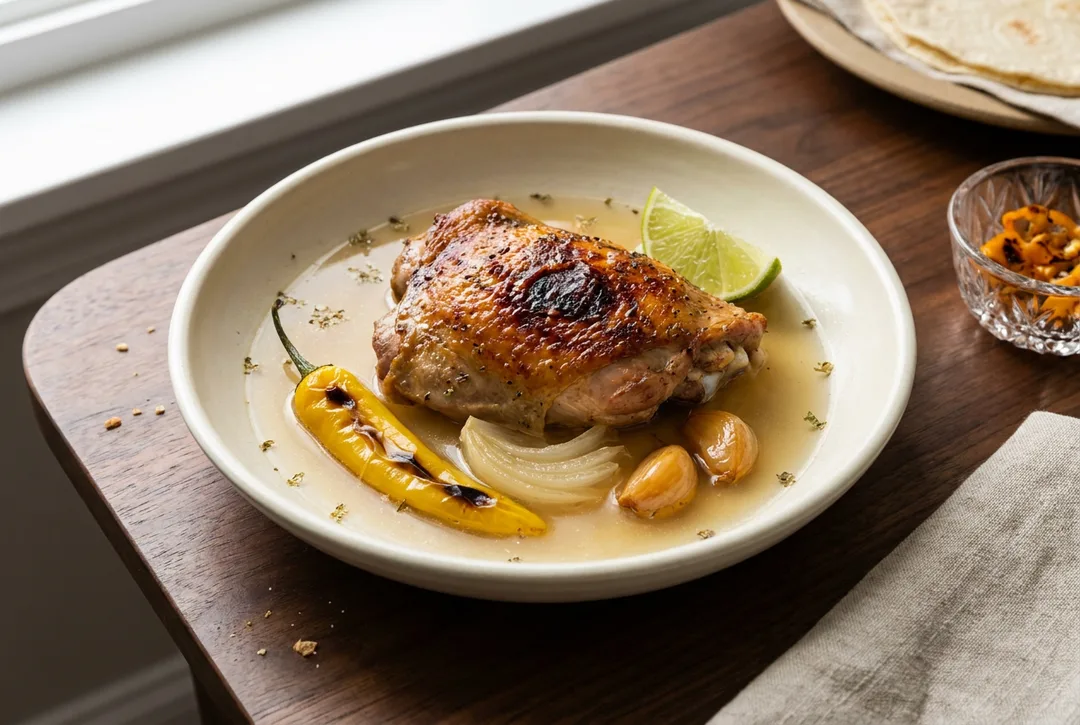
The name points east. In Yucatán, oriente means the eastern end of the state, and the city at its centre is Valladolid. Escabeche oriental is the dish Valladolid is known for beyond its own streets, and it turns up at fiestas, at patron saint celebrations, at long family Sundays, and in the cazuelas of market cooks who start before dawn. Turkey is the traditional bird. Chicken is common now and nobody objects, but turkey gives the broth a depth that chicken cannot quite reach.
It is not the Spanish escabeche most people picture, the cold one, the fish under oil and vinegar kept in a jar. This one is served hot, in a bowl, with the broth poured over. The vinegar is still the spine of it, but it is cut with a large quantity of toasted garlic, with oregano, and with the dark pepper-heavy spice paste that Yucatecan cooks call recado blanco or, plainly, recado para escabeche. Black pepper does the work here, not achiote. The colour on the plate is pale gold and brown, not red.
The step that separates a good escabeche from a flat one is the fire. The turkey is poached first in the spiced broth until it is tender, then taken out and charred over coals or under high heat until the skin blisters and darkens in patches. That smoke goes back into the bowl when the hot broth meets the meat. Skip it and you have a sour soup with boiled turkey in it. The chiles x'catic get the same treatment, charred until their skins loosen, then peeled and dropped in whole.
The other common mistake is treating the vinegar as a quantity rather than a balance. Straight white vinegar poured in at the end tastes like a mistake. It needs to simmer with the garlic and the onion so the edge softens into something round and sharp at once. Taste as you go. The finished broth should make you sit up, not wince. Tortillas, a wedge of lime and a little chopped habanero on the side are the whole of what else is needed.
Ingredients
26 items · for 6For the recado (spice paste)
- 2 tbsp black peppercorns
- 1 tsp allspice berries
- 6 whole cloves
- 1 tsp cumin seed
- 1 piece cinnamon stick, about 3 cm (canela, the soft Ceylon kind)
- 2 tbsp dried Yucatecan oregano
- 1 whole head of garlic, cloves separated and peeled
- 2 tsp fine salt
- 3 tbsp white vinegar, plus a little water to loosen
For the turkey and broth
- 2 kg turkey legs and thighs, bone in, skin on (or 2 kg chicken thighs and drumsticks)
- 3 litres water (12 cups)
- 1 white onion, halved
- 1 head of garlic, cut across the middle
- 3 bay leaves
- 1 tbsp dried Yucatecan oregano
- 2 tsp salt, plus more to taste
- 2 tbsp lard or neutral oil
For the escabeche
- 4 large white onions, about 800 g, sliced thin
- 250 ml white vinegar (1 cup)
- 2 heads of garlic, cloves separated and peeled, left whole
- 8 chiles x'catic (pale yellow chillies), or Hungarian wax or banana peppers
- 1 tbsp dried Yucatecan oregano, toasted
- Salt to taste
To serve
- Corn tortillas, warmed
- 3 limes, cut into wedges
- 1 habanero, charred and finely chopped, or a small bowl of chile tamulado
Step by step
8 stepsToast and grind the recado
Toast the peppercorns, allspice, cloves, cumin and cinnamon in a dry pan over medium heat for two or three minutes, until they smell warm and the cumin darkens a shade. Add the oregano for the last twenty seconds only, it burns fast. Grind everything to a fine powder in a spice grinder or molcajete. Char the peeled garlic cloves in the same dry pan until spotted brown and soft, then mash them in. Add the salt and the vinegar and work it into a thick, spreadable paste, loosening with a spoon of water if needed.
Season the turkey
Rub about two thirds of the recado all over the turkey pieces, under the skin where you can get at it. Reserve the rest for the broth. Leave the meat at room temperature for thirty minutes, or cover and refrigerate overnight, which is better if you have the time.
Poach until tender
Bring the water to a simmer in a large pot with the halved onion, the split head of garlic, the bay leaves, the tablespoon of oregano and two teaspoons of salt. Lower in the turkey pieces along with any recado left in the bowl. Simmer gently, never at a rolling boil, skimming the grey foam in the first ten minutes. Turkey legs take ninety minutes to two hours, chicken about forty five. It is ready when the meat pulls away from the bone under light pressure but still holds its shape. Lift the pieces out onto a tray and strain the broth, keeping all of it.
Char and peel the chillies
Over a gas flame, on a comal or under a hot grill, blacken the chiles x'catic on all sides until the skin blisters and lifts. Put them in a bowl covered with a plate for ten minutes, then rub off the loose skin with your fingers. Leave them whole with the stems on. Do not rinse them under the tap, you will wash away the smoke.
Build the vinegar broth
Heat the lard in a wide pan and fry the whole peeled garlic cloves over medium heat until golden on all sides, four or five minutes. Add the sliced onions and a good pinch of salt and cook until they are soft and translucent but not browned. Pour in the vinegar and let it bubble hard for two minutes to take the raw edge off. Add two litres of the reserved broth, the remaining recado and the toasted oregano, then simmer uncovered for twenty minutes. Taste. It should be clearly sour with sweetness behind it from the onion and garlic. Adjust with salt, more broth if too sharp, more vinegar if it has gone flat.
Char the turkey
Get coals hot, or a grill pan or broiler as hot as it will go. Lay the poached turkey pieces skin side down and leave them until the skin blisters, darkens in patches and crisps at the edges, about five minutes, then turn and give the other side two or three. The meat is already cooked, so this is purely for colour and smoke. Watch it, the recado has enough sugar in the garlic to catch.
Bring it together
Slide the charred turkey and the peeled chillies into the simmering vinegar broth. Let everything sit together over the lowest heat for ten minutes so the meat takes on the sourness and the broth takes on the smoke. Do not let it boil at this stage or the skin will slacken.
Serve hot
Give each person a piece of turkey and a whole chilli in a wide bowl, then ladle over plenty of broth with the onions and soft garlic cloves. Tortillas, lime and chopped habanero on the table. People eat it with their hands as much as with a spoon.
Notes from the kitchen
- Chiles x'catic are hard to find outside the peninsula. Hungarian wax peppers or banana peppers are the closest match in flesh and mild heat. Pale green anaheims work at a push but are sweeter.
- Yucatecan oregano is a different plant from Mediterranean oregano, broader leaved and more floral. Mexican oregano from a Latin grocer is the right substitute. Use two thirds the amount if all you have is Mediterranean.
- The broth improves overnight and keeps four days refrigerated. Store the turkey separately so the skin does not go to mush, and char it again briefly when you reheat.
- If turkey legs are not available, a whole chicken cut into eight works well and cuts the poaching time by half. Keep the bones in either way, the broth depends on them.
This is the standard household and market version cooked across the east of Yucatán, with the recado made from scratch rather than bought in a block.
This photograph was generated with artificial intelligence and may differ from the finished dish.