
Dzotobichay is one of the older things still cooked in Yucatecan kitchens. Corn masa, chaya leaves, pumpkin seed and egg: four ingredients that were all here before the Spanish arrived, held together in a roll and steamed. The name carries the Maya word chay, which is chaya, the leaf that grows as a shrub in half the yards on this peninsula and asks for almost nothing in return.
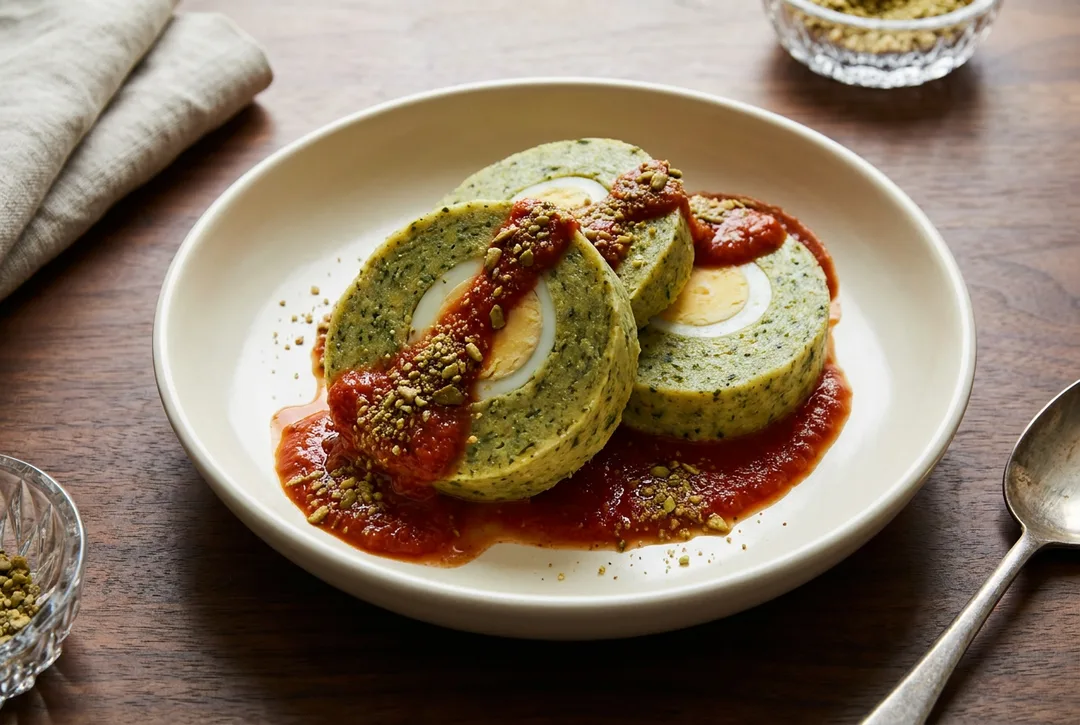
Around Tulum and across Quintana Roo you are most likely to meet it at breakfast or at a late morning market stall, cut into thick rounds, the ring of hard boiled egg sitting in the middle of green flecked masa, the whole slice buried under chiltomate and a heavy dusting of ground pepita. It also turns up at wakes and novenas and on the tables set out at the end of October, because it travels well, feeds a crowd, and keeps for the walk.
The taste is quieter than people expect. Chaya is not bitter and not grassy; cooked, it goes soft and mild and slightly mineral, closer to chard than to spinach. The weight comes from the pumpkin seed, which is toasted and ground to a coarse meal and goes both inside the roll and over the top, giving a dry, nutty richness that the tomato sauce cuts through. Without the sauce the whole thing is a little austere. With it, the balance is right.
Two things get muddled. The first is the relationship with brazo de reina, which is the same idea built as one long roll and sliced; some cooks use the two names for the same dish, others reserve dzotobichay for the smaller individual parcels. Neither camp is wrong. The second matters more: chaya must be cooked before it is eaten. The raw leaf contains compounds that break down with boiling, so it goes into water for a few minutes before it goes anywhere near the masa. Nobody here eats it raw, and the step is not optional.
If you are cooking outside the peninsula, chaya is the hard part. Chard or mature spinach will give you a tamal that works and tastes good, though it will be a different dish and worth calling by a different name.
Ingredients
13 items · for 6For the roll
- 300 g fresh chaya leaves, thick stems removed (about 8 packed cups)
- 1 kg fresh white masa for tamales, or 500 g masa harina mixed with 600 ml warm water
- 150 g pork lard, soft (about 2/3 cup)
- 2 tsp fine salt
- 6 eggs, hard boiled and peeled
- 200 g raw hulled pumpkin seeds (about 1 1/2 cups), for toasting and grinding
- 500 g banana leaves, fresh or frozen
- Kitchen string
For the chiltomate
- 8 ripe plum tomatoes (about 800 g)
- 1/2 white onion, peeled
- 1 habanero chilli, whole
- 1 tbsp lard or neutral oil
- 1 tsp salt, or to taste
Step by step
9 stepsToast and grind the pepita
Put the pumpkin seeds in a dry heavy pan over medium heat and stir constantly. They will pop and swell and turn a shade darker in four or five minutes. Take them off before they brown properly, because scorched pepita turns bitter and there is no fixing it. Cool completely, then grind in a food processor or blender in short pulses to a coarse, sandy meal, not a paste. Set aside about a third for serving.
Boil the chaya
Bring a large pot of salted water to the boil and drop in the chaya leaves. Boil for 10 minutes, uncovered, in a stainless or enamel pot rather than aluminium. Drain, press out the water firmly with the back of a spoon, and chop fine. You should have roughly 1 1/2 cups of chopped cooked leaf, dark green and soft.
Soften the banana leaves
Wipe the leaves clean and cut them into rectangles about 30 by 25 cm. Pass each piece over a gas flame or lay it briefly on a hot dry comal until it turns glossy and deepens in colour and goes pliable. Unsoftened leaf cracks along the ribs when you roll it. Keep a few spare pieces for patching and for lining the steamer.
Work the masa
Beat the lard with the salt until pale and light, a minute or two by hand or with a mixer. Add the masa in three additions, working it in until the dough is smooth, soft and a little tacky, closer to thick batter than to bread dough. If it feels stiff, add warm water a spoonful at a time. Fold in the chopped chaya until the green is evenly distributed through the whole mass.
Form the rolls
Lay a banana leaf rectangle shiny side up. Spread about a sixth of the masa over it in a rectangle roughly 20 by 14 cm and 1 cm thick, leaving a clear border. Scatter a heaped tablespoon of ground pepita down the centre and lay a whole hard boiled egg on top, lengthwise. Using the leaf to lift, bring one long edge of masa over the egg and roll it up so the egg is sealed in the middle. Fold the leaf over the roll, tuck the ends under and tie with string. Repeat for the other five.
Steam
Line the base of a steamer or a large pot fitted with a rack with spare banana leaf. Add water to just below the rack, stack the rolls seam down, cover with more leaf and a tight lid, and steam over a low rolling boil for 1 hour and 15 minutes. Check the water every 25 minutes and top up with boiling water. The tamal is done when the masa has firmed, smells of cooked corn, and pulls away cleanly from the leaf when you open one to look.
Make the chiltomate
While the rolls steam, char the tomatoes, onion half and habanero on a dry comal or under a grill, turning until the skins are blackened in patches and the tomatoes are collapsing, about 12 minutes. Peel what skin comes away easily and discard the habanero stem. Blend the tomatoes and onion to a loose sauce, with the habanero if you want heat and without it if you do not. Heat the lard in a pan, pour in the sauce and simmer 10 minutes until it thickens slightly and the raw tomato edge is gone. Salt to taste.
Rest and slice
Let the rolls sit in their leaves for 10 minutes off the heat so the masa settles. Untie, open the leaf and cut each roll across into rounds 3 cm thick. The yellow of the egg should sit in the centre of the green flecked masa.
Serve
Lay two or three rounds per plate, spoon hot chiltomate over them so it pools at the base, and finish with a generous scattering of the reserved ground pepita. It is eaten warm, with a spoon, and the leaf is not eaten.
Notes from the kitchen
- Chaya must be boiled before eating, never used raw, and is best cooked in stainless or enamel rather than aluminium. Outside the peninsula, substitute Swiss chard or mature spinach, boiled 3 minutes and squeezed very dry, using the same weight before cooking.
- Without banana leaf, use baking parchment to roll and shape, then wrap the parcel in foil before steaming. You lose the leaf perfume but the texture is the same.
- Masa harina works: mix 500 g with 600 ml warm water, let it stand 20 minutes, then proceed. It will want a little more lard than fresh masa to stay tender.
- The rolls keep three days in the fridge, still wrapped, and reheat best by steaming for 15 minutes. The chiltomate keeps a week and the ground pepita a fortnight in a sealed jar.
This is the standard household and market version made across the peninsula, with the egg whole in the centre rather than chopped, which is the form sold at breakfast stalls here.
This photograph was generated with artificial intelligence and may differ from the finished dish.