

Sargassum has returned to the beaches of the Mexican Caribbean, and Tulum's municipal tourism office is not waiting for the seaweed to clear. This season, cenotes and freshwater lagoons are the pitch.
Haydé Hernández Pastrana, the municipality's director general of tourism, confirmed a push to diversify the destination's offer beyond its coastline, with a strategy that repositions Tulum's network of inland cenotes, lagoons, and Mayan jungle routes as draws that sargassum cannot compromise. The plan extends through a series of international trade fairs running from September to November across three continents.
The context is familiar. Sargassum, the brown macroalgae that drifts across the Atlantic from the Sargasso Sea, has accumulated each spring and summer along the Riviera Maya with growing intensity since the mid-2010s. Beaches that were once reliably clear from May through October have become difficult to forecast, and destination managers throughout Quintana Roo have been forced to adapt their messaging accordingly.
"We have tremendous natural wealth in Tulum, with cenotes, lagoons, and ecotourism experiences that continue to draw visitor interest," Hernández Pastrana said. "The goal is to strengthen their promotion and position them as a fundamental part of the Tulum tourism experience."

Why Cenotes Are More Than a Backup Plan
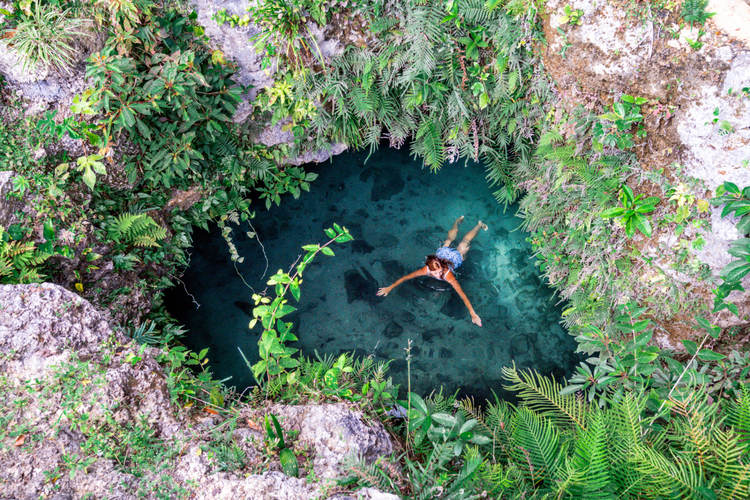
Tulum sits above one of the most extensive cave and cenote systems in the world. The freshwater pools and underground rivers that characterize the region's geology are not a consolation prize for visitors who arrive during a difficult sargassum week. For a significant portion of travelers, they are the reason to come at all.
Cenotes connect directly to the broader story Tulum has been building for years: Mayan cultural heritage, ecological depth, a destination defined by what lies beneath the surface rather than what washes up on it. The archaeological zone, the Sian Ka'an Biosphere Reserve, and the inland cenote routes running toward Cobá form a complementary axis that can sustain a multi-day itinerary without the beach ever becoming the central element. Tulum's cenote network ranks among the most consistently searched topics in the region, a signal of how strongly that offer resonates with international visitors.
The directorate's move reflects both an acknowledgment of a recurring environmental challenge and a recognition that the product is already there. It just needs more consistent international exposure.

A Trade Fair Calendar That Spans from Paris to London
The municipality has outlined four upcoming events where Tulum will make its case to international and domestic travel buyers.
The first is Top Resa, scheduled for September 15 through 17 in Paris, France. One of the most important tourism industry fairs in Europe, Top Resa draws tour operators, agencies, and destination representatives from across the continent. For Tulum, which has cultivated a loyal European visitor base, the fair is a direct channel to the buyers who shape vacation packages months in advance.
In Mexico, the municipality will attend the Encuentro de Pueblos Mágicos in Tampico, Tamaulipas, a national gathering for destinations holding the federal Pueblo Mágico designation. The exact dates have not yet been confirmed. The circuit offers access to domestic travel operators and regional tourism boards, and Tulum's inland and cultural offer tends to resonate more strongly with Mexican travelers who already know the beach product.
The Cancún Travel Mart, running October 21 through 23, brings the pitch back to the Mexican Caribbean. One of the primary tourism business meetings in the region, it connects Caribbean destinations with buyers from North America, Latin America, and Europe in a setting where Tulum's proximity and complementarity with Cancún can be part of the message rather than a source of competition.
The schedule closes at the World Travel Market in London, November 3 through 5. WTM is among the largest global travel trade shows, pulling in representatives from virtually every destination of scale. A consistent presence there signals that Tulum is competing for premium long-haul travelers, not just regional arrivals.
"We trust that these actions will allow Tulum to maintain its competitiveness, boost visitor arrivals, and diversify the tourism offering beyond sun and beach," Hernández Pastrana said.
The Promotion Is the Gap, Not the Product
What the directorate is attempting to close is not a product gap but a marketing one. Tulum's cenotes are not undiscovered. They appear in international travel media, generate consistent coverage in tourism publications, and have their own booking infrastructure. But they tend to be presented as a day-trip complement to beach tourism rather than as a standalone motivation: something travelers do on the day the coast looks rough.
Repositioning cenotes and lagoons as a primary reason to visit Tulum, rather than a fallback, requires sustained messaging in the rooms where itineraries get built. Trade fairs, agency presentations, and tour operator briefings are precisely where that work happens. The September-through-November calendar is designed for that audience.
If sargassum continues to shape the Caribbean tourism landscape, and the scientific evidence suggests it will, destinations that build identities not entirely dependent on beach conditions will carry a structural advantage through the summer months. Tulum already has the geography and the infrastructure. The question the trade fair circuit will answer is whether the promotional story can land before the beaches define the season's narrative again.
For visitors planning travel during the late summer or fall, the directorate's message is straightforward: the water is clear. It is just underground.
Have you planned a Tulum trip around cenotes instead of the beach, and was it enough to make sargassum irrelevant? Join the conversation and share your perspective with us on Instagram and Facebook at @thetulumtimes .