

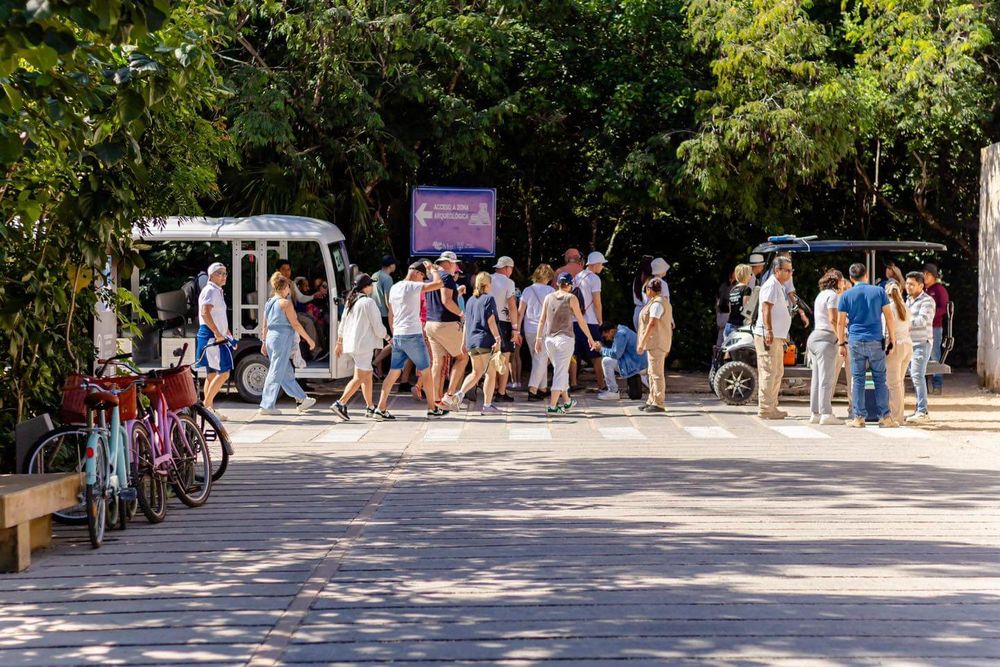
Residents in Tulum have reported new service failures at Jaguar Park, operated by Grupo Mundo Maya, after the park’s internal electric vehicle transport stopped running on Sundays without prior notice, complicating mobility for thousands of visitors who travel to the protected area.
According to citizen reports, local residents still have free access to the park on Sundays, but private vehicles are not currently allowed to enter. At the same time, the electric vehicles used to move visitors within the park are not operating that day. The combination has forced many users to walk long distances to reach the beaches inside the park’s boundaries, prompting frustration among people who visit the area for recreation.
The issue matters in Tulum because Jaguar Park is one of the municipality’s most visible public coastal spaces, and access conditions inside the site directly shape who can realistically use it. A free entry policy has limited value when basic mobility inside the park is unavailable.
Free entry, limited access
Residents say the problem is not the Sunday access policy itself, but what happens once people are inside or trying to move through the park. With no private cars allowed and no electric transport service operating, visitors must cover long stretches on foot to get to the beach areas within the park polygon.
That has become especially difficult for families with small children, older adults, and people who have trouble walking long distances in the high temperatures that are common in the region. For those groups, a day at the park can quickly shift from accessible to burdensome.
“It’s supposed to be a benefit for locals, but if there’s no transport and they don’t allow cars in, it’s very difficult to get to the beach,” one affected user said, requesting anonymity.
The complaint points to a broader gap between formal access and usable access. In practical terms, residents are describing a system in which entry is technically available, but reaching the main destination still requires a demanding walk under the sun.
Families and older adults feel the impact
The concerns raised by residents focus on who is most affected by the service suspension. Visitors say the lack of internal transportation reduces the usefulness of the free Sunday benefit for people who cannot easily make the trip on foot.
For families, that can mean carrying supplies and accompanying children over long distances. For older adults, the route can become physically exhausting. For anyone with mobility limitations, the current arrangement may function as an effective barrier even though the park remains open.
That distinction is important for a place presented as a public recreational area. Access policy is not defined only by who is permitted to enter, but also by whether people can move through the space safely and reasonably once inside.
And in Tulum, where heat can intensify the physical strain of walking exposed routes, transportation inside a large natural area is more than a convenience. Residents are describing it as a necessary condition for the Sunday benefit to work as intended.
Complaints revive earlier concerns
Jaguar Park has been a subject of debate since its opening because of the access control measures applied inside the area. Those measures include vehicle restrictions and different rules governing entry for visitors.
The new complaints do not introduce a separate controversy so much as deepen an existing one. Residents are now pointing to operational problems that affect day-to-day use of the park, particularly on the one day when local access is promoted as free.
That gives the latest criticism a specific local dimension. The concern is no longer only about rules on paper, but about how those rules interact with the services available at the site. When transport is suspended without warning, residents say the burden falls directly on park users rather than on the operator.
The result is a mismatch between the stated public benefit and the on-the-ground experience. A mobility problem inside the park changes how the free Sunday policy functions in real terms.
Public beach access opened in 2025
The latest complaints come months after the federal government opened the first two public access points to the beaches of Jaguar National Park in November 2025, guaranteeing free entry 365 days a year for domestic visitors, foreign visitors, and Quintana Roo residents.
That decision established a clear public-access framework for the beaches inside the protected area. But the current complaints suggest that guaranteed entry does not fully resolve how people reach those spaces once they are inside the park or approaching its internal routes.
This is where the present dispute becomes more concrete for Tulum residents. Public access to the coast is one issue. Internal mobility within the park is another. Citizens now argue that the second issue is weakening the practical effect of the first, at least on Sundays, when locals are meant to benefit from free admission.
The difference may seem administrative, but for visitors on the ground, it shapes the entire visit. If a family arrives expecting a low-cost day at the beach and then faces a long walk with no transport option and no ability to enter by private vehicle, the visit becomes harder to complete.
The Tulum Times has closely followed how public access measures at major local sites translate into everyday use. In this case, the complaints reflect a familiar tension in the municipality: a formal access policy can still leave residents with limited workable access if basic operations fail.
What changes on Sundays now
For now, according to the citizen reports, Sunday visitors face a more restrictive reality inside Jaguar Park than the free-access policy alone suggests. They may enter without charge if they are part of the local population, but they cannot currently rely on internal electric transport, and they also cannot enter with private vehicles.
That means Sunday trips require more planning, more walking, and greater physical effort. People who can comfortably walk the distance may still use the park, but others may decide the trip is no longer feasible. In that sense, the operational change does not affect all visitors equally.
Who is directly affected is already clear from the complaints: local families, older adults, and anyone with limited mobility bear the greatest burden. But the impact is broader than that. A public space that becomes harder to use on the day meant to benefit local residents risks undermining confidence in how the site is being managed.
Residents have framed the problem in simple terms. A free benefit loses part of its purpose when the conditions needed to use it are missing. That is now the central issue surrounding Jaguar Park on Sundays.
What is at stake is not only convenience, but whether public coastal access in Tulum remains usable for the people it is supposed to serve. Going forward, the Sunday transport shutdown at Jaguar Park changes the experience of local access by making internal mobility more difficult just when many residents are meant to benefit most.
We’d love to hear your thoughts. Join the conversation on The Tulum Times’ social media.
How should Jaguar Park balance access rules with the mobility needs of local visitors?